|
 |
|
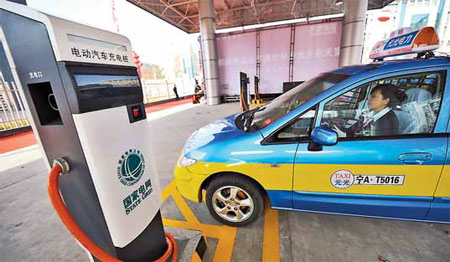
An electric taxi at a recharge station for a battery change in Yinchuan, Ningxia Hui autonomous region. [Photo/ Xinhua] |
Shenzhen, a city with a reputation for setting trends, has been attempting to lead the push for motorists to switch to electric vehicles.
The metropolis in Guangdong province already has a fleet of 1,300 electric buses and 700 taxis on its roads, and authorities in this city in South China had hoped to see that increase in the near future.
Yet, a fatal car crash last month may have put a serious dent in that ambition.
On May 26, a Nissan GTR rear-ended two taxis while traveling at an estimated speed of 180 km/h. The driver was detained and is suspected of drunken driving.
The collision caused one of the taxis - an e6 electric vehicle manufactured by BYD - to veer into trees and catch fire, resulting in the deaths of its driver and two passengers.
Although BYD, a Chinese automaker, released a statement three days after the crash to insist its vehicles had passed crash testing and met national safety standards, it was not enough to stem the growing public concern over electric cars.
"In the past, I couldn't take an electric taxi because there were only 700 available and too many people wanted to try it," said Huang Weihua, an art dealer in his 30s from Shenzhen, Guangdong province. "Now I don't dare to take one."
Despite several favorable policies, electric vehicles have so far failed to gain much popularity in China.
In April, the Ministry of Industry and Information Technology announced plans to help sales reach 500,000 vehicles by 2015 and 5 million by 2020.
The target would be a major increase from the 8,159 electric vehicles sold last year (almost all went to government fleets).
According to the China Association of Automobile Manufacturers, automakers sold 1,499 hybrid cars and 1,830 all-electric cars in the first quarter of 2012.
"Electric vehicles are mostly used by the public sector, such as public transport and city sanitation, although the government plans to increase the number used as taxis and by logistics companies," Li Weili, an economist at the State Information Center, said at a recent news conference in Beijing during a forum on the strategic development of emerging industries.
However, convincing private car buyers to make the switch from gasoline to electric will be hard.
"The price of an electric vehicle is as high as a regular car, so it's less attractive to customers," said Bian Ying, a car saleswoman for BYD in Beijing's Chaoyang district.
For example, the BYD e6, which is fully electric and will go on general sale in August, costs 368,000 yuan ($57,900). Bian said the government is offering a 200,000-yuan subsidy for each unit, but that still leaves almost 200,000 yuan for the buyer to cover.
"Even with the subsidy, the price is close to some foreign brand models," she said. "No one even asked about the car before Beijing's (car registration) policy came into force."
Beijing implemented its "license lottery" to restrict the number of new car purchases in January 2011. However, the city traffic authority said last month that buyers of electric cars would receive special plates, allowing them to avoid the draw.
"Many people called to ask about the electric cars after that policy was announced, but price is still their top concern," Bian said.
Zhao Ruotong, a 21-year-old motorist in Beijing, said it is not even the initial purchase price that is stumbling block. "The subsidy isn't going to cover the cost of changing the battery, which is also expensive," she said.
According to a report by Liangbao newspaper, which quoted Qiu Xinping, a Tsinghua University chemistry professor, the average lifespan of electric car batteries is roughly three years. However, to replace it would cost about 25 percent of the vehicle's original price tag.
"With the money, I would rather buy a (Honda) Accord, or add some money to get a (Volkswagen) Tiguan, which is surely a more famous brand," said Liu Qiu, another Beijing motorist.
"Although gas prices are much higher than the price of electricity, a car is not only a transport tool, it also represents your economic status. If I was young, I might consider buying an electric car, but now I'm 50 and I need to enjoy a better standard of living."
chengyingqi@chinadaily.com.cn

Copyright 1995 - . All rights reserved. The content (including but not limited to text, photo, multimedia information, etc) published in this site belongs to China Daily Information Co (CDIC). Without written authorization from CDIC, such content shall not be republished or used in any form. Note: Browsers with 1024*768 or higher resolution are suggested for this site.
License for publishing multimedia online 0108263 Registration Number: 130349