Mounting pressure
Wang isn't alone in his opposition to the proposal. A survey conducted by the People's Daily Web portal on June 11 showed that 93.3 percent of the 450,000 respondents would vote against a rise in the retirement age.
In response to the mounting pressure, the ministry changed its tune on June 19, saying that a decision has been put in abeyance because more research is needed, but there is still debate about when the change should be implemented and differences of opinion remain about whether the retirement age should be raised, when it should happen and what that new age should be.
"An extension of the retirement age would be bad news for the majority of laborers. Judging by the experience of other countries, the idea always receives more support from government officials and white-collar employees than from blue-collar workers," said Tang Jun, a social policy researcher at the Chinese Academy of Social Sciences.
 |
|
Retired residents of Huaying city, Sichuan province, dance in a park on June 2. More than 10,000 city retirees attend dance events held by communities every day. Qiu Haiying / for China Daily |
"For white-collar workers such as government officials, teachers, doctors, accountants and engineers, aging means experience and an accumulated advantage, but for those engaged in physically intensive labor, aging just means that work becomes harder. Those people are more vulnerable and many men lose their jobs when they reach 50, while women lose out in their 40s. Without a stable income, where will their pensions come from?" he asked.
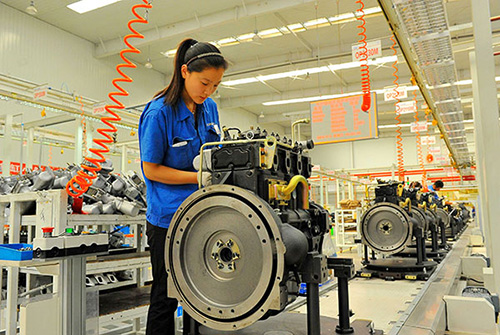
According to Zhao Yingjie, human resources supervisor at Beijing Fulham Electronic Co, most of her company's workers are aged between 20 and 35 and only a few on the assembly lines are older than 40.
Moreover, 20 to 24 million new workers enter the labor force each year, but there are only around 10 million new jobs available, 30 percent of which are the result of natural wastage, according to Tang, who said an extension of the retirement age would definitely affect the employment prospects of young people, especially recent graduates. "If the retirement age were delayed, 3 to 4 million jobs would disappear annually," he said.
Further exacerbating the problem, young people lack the experience and expertise required to move seamlessly into the jobs vacated by their elders, said Yang Yansui, director of the research center of employment and social security at Tsinghua University.
"Young people's employment would be affected, but not on a huge scale," she said. "Instead, the government should make efforts to create jobs in the tertiary industry, which absorbs most graduates, and should also encourage young people to start their own businesses."

An inequitable system
The number of Chinese nationals aged 60 or above reached 185 million last year, accounting for 13.7 percent of the total population, according to statistics published by the China National Committee on Aging. By 2015, that figure will hit 221 million, 16 percent of the total population.
The number of people in urban areas receiving a basic pension had soared to 283 million by the end of 2011, the Ministry of Human Resources and Social Security said in a recent report, and there were more than 68 million new pensioners, a rise of 5.21 million from 2010.
What's more, a joint study conducted by the Bank of China and Deutsche Bank suggested that the aging population will leave the country with a pension fund shortfall of 18.3 trillion yuan by 2013, creating a heavy fiscal burden, according to reports by Xinhua News Agency.
Yin Weimin, minister of human resources and social security, confirmed at a news conference in March that 13 provinces had pension fund shortfalls in 2011 and the fiscal budget had contributed roughly 180 billion yuan to offset them.
Yu Zhengsheng, the Party chief of Shanghai, told a meeting last year that the city would allocate more than 10 billion yuan in its annual budget to bridge the gap. Meanwhile, to offset the shortfalls, some local governments are using money from individual accounts and gradually depleting them, said Xu Yanjun, deputy director of the Social Insurance Administration under the Ministry of Human Resources and Social Security.

Taking those factors into account, if everyone in China worked an extra year, pension funds would be boosted by more than 4 billion yuan, while payments would be reduced by 16 billion yuan, according to calculations by Zheng Bingwen, head of the Global Pension Fund Research Center at the Chinese Academy of Social Sciences.
It sounds like a good deal, so why has it provoked such strong public opposition?
"The promotion of an extension to the retirement age should at least satisfy an essential precondition that our country can solve its historical pension debt smoothly through the fiscal system without depending on enterprises and individuals, but obviously, now is not the right time," said Zhang Zhanxin, an expert in social security studies at the Chinese Academy of Social Sciences.
A report released by Institute of Social Security under Renmin University of China in 2005 estimated that the government would have to pay 8 trillion yuan into the pension pot from 1997 to 2033.
Meanwhile, the China Pension Report 2011, conducted by CASS, showed that although government subsidization of pensions has increased rapidly since 1997 and the accumulated subsidies exceeded 1.25 trillion yuan by the end of 2011, but that's a drop in the ocean in the face of a debt shortfall of 8 trillion yuan.
"The government should solve the historical debt problem first so the public can see how pension funds were received and spent, otherwise the pension account will always be a mess," commented Zhang.
'Double-track' system
"People are not simply opposed to delaying their retirement, but they are also against the inequities inherent in the pension system," said Zhang.
China operates a "double-track" system. The State pays the contributions of employees of governmental organizations and institutions, but the rules are different for those working for other enterprises, who have to pay for themselves. Generally, employees of government organizations and institutions receive a much higher pension than enterprise employees.
"The enterprise employees' pension insurance system was reformed in 1995, but the system for employees of government organizations and institutions wasn't reformed at the same time," said Zheng Gongcheng, director of China's Social Security Research Center at Renmin University.
The double-track system emphasizes the many differences between the two groups. The pensions of enterprise employees only increase marginally with inflation, but former employees of government organizations and institutions have pensions that rise in tandem with the salaries in their old workplace, leading to a widening gap between the two groups.
"When you look at pension provision in other countries, almost all of those systems are designed to promote fairness. Obviously, China's current pension system is not," said Zheng. "We can't say the government didn't make an effort, but the fact is those attempts failed to have any obvious effect. Why do the reforms so seldom work? Many people from government organizations and institutions don't want to give up their high pensions. That's why graduates are so keen to take the examination for government service. Besides, a rational, practical reform plan is not available," he added.
The pension gap
Miao Liang, 57, a Beijing resident, was made redundant from his job in a steel foundry 10 years ago. "To tell the truth, I have never earned 3,000 yuan a month in my life. Now I work on a construction site as a doorkeeper and the salary is 1,500 yuan, out of that I have to use 500 yuan for my pension account," he said.
"When I was in the foundry, I was often voted employee of the year, but sadly, it went bankrupt. Even as a doorkeeper, I am still contributing to society. Why do civil servants receive more than 4,000 yuan a month when they retire, but ordinary workers only get about 1,000 yuan. I'm in poor health now and if the retirement age is raised, maybe I won't even reach pensionable age. It's just unfair," he said.
"So many problems related to the system have not been solved yet, so to promote the extension of the retirement age will not only fail to solve the real problems, but will also increase public resentment," said Zhang Zhanxin.
"The reform of China's pension system should be carried out as soon as possible, but it should be undertaken on a step-by-step basis, to minimize any resistance in the future," said Zheng Gongcheng. He urged that the first step should be the establishment of a basic pension insurance system for employees of government organizations and institutions and said that they need to pay a certain proportion of the pension insurance themselves, just as enterprises workers do. Second, the country needs to gradually reduce the pensions of workers in government organizations and institutions to narrow the gap with enterprises workers. Third, the mechanism whereby the government workers' pensioeds to gradually reduce the pensions of workers in government organizations and institutions to narrow the gap with enterprises workers. Third, the mechanism whereby the government workers' pensions increase in lockstep with salaries needs to be scrapped.
Tang of CASS also called for a fair and uniform national pension system. "A self-sustaining social security system should depend on contributions from new workers and effective investment. However, on the one hand, there are more pensioners than contributors in an aging society, and on the other, it's difficult for pensions funds to beat inflation through investment when many countries are facing a financial crisis," he said.
Every province, municipality and autonomous region in China has its own system, so the profits and losses of pensions funds vary because the number of retirees and contributors changes from region to region.
The pensions pot is also suffering because tens of millions of workers in State-owned enterprises were forced to retire in 1998 to reduce staff numbers and improve efficiency. Those workers retired at an average age of 47, but were not obliged to put extra cash into a public fund, meaning that their pensions are being funded by today's employees, according to Tsinghua's Yang.
Caring for a country's elderly population is more a problem of wealth distribution than insurance. Formulating a balanced distribution system and implementing the reforms rapidly would be more effective and be more popular with the general public than simply imposing a heavier burden such as extending the retirement age, said Tang.
Contact the writers at hena@chinadaily.com.cn and chenxin1@chinadaily.com.cn


Copyright 1995 - . All rights reserved. The content (including but not limited to text, photo, multimedia information, etc) published in this site belongs to China Daily Information Co (CDIC). Without written authorization from CDIC, such content shall not be republished or used in any form. Note: Browsers with 1024*768 or higher resolution are suggested for this site.
License for publishing multimedia online 0108263 Registration Number: 130349