China still has considerable room to adjust economic policy and thus won't face a "hard landing" this year, former US Treasury Secretary Henry Paulson said on Tuesday.
Just back from a trip to China, the man who led President George W. Bush's 2008 bailout of Wall Street shared observations about the country and his new blueprint for upgrading economic relations between the world's two biggest economies.
"There's no doubt that the economy has slowed down significantly, and in a number of areas, really slowed down," Paulson said in an address at the Atlantic Council, a think tank in Washington.
"My own best judgment is that we're not going to see a hard landing," he added.
Economists describe "a hard landing" as a severe slowdown or even contraction of a country's gross domestic product into a recession, which follows a period of rapid growth. The cause is often a government's attempts to control inflation by tightening the money supply.
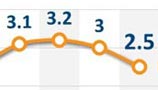
Last week, China reported that its economy grew 7.6 percent in the second quarter, the lowest rate in more than three years. On Monday, the International Monetary Fund lowered its estimates for Chinese growth for this year and 2013, warning of the possibility of a hard landing in the medium term.
The IMF dropped its forecast for this year's GDP growth to 8.0 percent from its forecast of 8.2 percent in April.
Paulson, who met with dozens of government and business leaders on his recent trip, said the Chinese have recognized and begun to address problems posed by its overheated real estate market and inflation.
"There is a lot of room in their economy - unlike ours - to respond positively to monitor the economy, loosening up lending and so on," he said. "I will be quite surprised if they don't grow somewhere between 7.5 to 8 percent this year."
But the bigger challenge for China will come three to five years from now, when its growth model, which is mainly driven by investment and exports, is "running out of steam" and reforms are lagging.
The former top executive of Goldman Sachs Group Inc, who as Bush's treasury secretary oversaw the rescue of it and other Wall Street banks, is now in academia. In 2011, he founded the Paulson Institute at the University of Chicago with an initial emphasis on strengthening the US-China relationship through trade and investment.
He has written "A New Framework for US-China Economic Relations", a tract that urges the two countries to maintain close economic ties even as the US consensus in support of this is eroding after more than 40 years. He recommends that Washington and Beijing push through reforms to adjust to new conditions.
"Our best interest is having a constructive relationship with China," he writes of the United States.
"There is a great opportunity in the economic area to break ground and do things that will benefit our economy, the global economy and China.
"For our part, the United States needs a level playing field in China," Paulson's report adds. "But we would benefit, too, from more investment from China."
The US needs to ensure greater openness to Chinese investment, grant China market economy status on a sector-by-sector basis and reform its outdated export-control system, he wrote.
Pointing out that China has been investing heavily abroad since 2009, Paulson said he believes this trend will accelerate over the next decade and that it is in the interest of the US to garner a "fair share" of Chinese investment cash.
But the US is "lagging way behind" in attracting capital from Chinese investors, he said, because "they feel unwelcome here" and "are confused by the different regulatory constraints and are put off by them".
For its part, China should pursue reforms to make the yuan a currency whose value is determined by the market, open up its capital markets, increase transparency, and enforce intellectual property commitments, Paulson writes.
tanyingzi@chinadailyusa.com

Copyright 1995 - . All rights reserved. The content (including but not limited to text, photo, multimedia information, etc) published in this site belongs to China Daily Information Co (CDIC). Without written authorization from CDIC, such content shall not be republished or used in any form. Note: Browsers with 1024*768 or higher resolution are suggested for this site.
License for publishing multimedia online 0108263 Registration Number: 130349