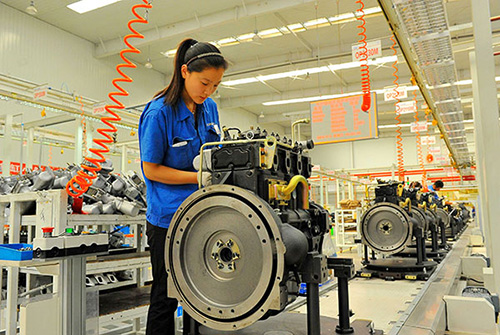
A slowing economy and the exit of stimulus policies have put brakes on China's auto industry, sending auto sales to a historical low after explosive expansion.
However, industry analysts believe the recovery of the world's largest car market is gradually accelerating, although purchase restrictions and poor economic prospects threaten to sap demand, especially since a second round of industry stimulus policies will not likely occur.
Auto sales climbed 2.9 percent in the first half from a year earlier to 9.6 million vehicles, indicating stronger signs of slowing down compared with the 3.4-percent gain registered the previous year and a 48-percent surge in the first half of 2010, data from the China Association of Automobile Manufacturers showed.
Growth slowed following China's economic slowdown, as the country's GDP growth waned for six consecutive quarters to 7.6 percent in the April-June period, the weakest gain in three years.
According to a CAAM report, in the first six months, sales of commercial vehicles slumped 10.4 percent from the same period in 2011, suggesting unusually weak industrial activity.
The auto industry is undergoing a difficult period consistent with decelerating economic growth in China, Fitch Ratings said.
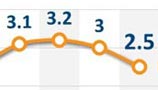
Auto sales growth in China dropped rapidly in 2011 to 2.5 percent from 32.4 percent in 2010, a sharp brake from robust growth in previous years.
Fitch said China's auto industry has still maintained "firm prospects beyond the current slowdown", as a low auto penetration rate, rising urbanization and a steady increase in household incomes will continue to generate significant growth over the mid- to long-term.
Michael Jiang, an advisory partner at KPMG China, regards the current slowdown as a period of adjustment. "Super-speedy growth in the last few years sort of overdrew a portion of future consumption, but we are optimistic about the market," Jiang said.
"The potential of the second, third and fourth-tier cities as car purchasing hubs is quite large," said James Chao, Asia-Pacific director with IHS Automotive Consulting. "The vehicle density of these cities is far lower than the vehicle density of the larger cities, and consumers' desire to own vehicles is quite high in these areas."
Although current figures indicate that the slump is not likely to end soon, some analysts believe the market will pick up in the coming months, with new policies set to moderate risks.
The Chinese government, spooked by deteriorating economic data, shifted its priority from cooling inflation to reversing the economic downturn late last year, ratcheting up investment in clean energy and relaxing lending with interest rate cuts.
"The overall China auto market is already seeing signs of improvement. We will most likely see the results of stimulus and easing policies towards the latter half of the year," Chao said. "While inventories are rising, we have also seen price discounts by the OEMs and dealers, which will help improve sales."
CAAM predicted car sales may grow by 5 to 8 percent this year, at least double the growth seen in 2011.
China's auto industry has been gradually reversing its downturn and mitigating the effects caused by the exit of the stimulus package, said Yao Jie, deputy general secretary of CAAM.
Reflecting unwinding pressure on the auto industry, a CAAM report said car sales in China rebounded in the second quarter by 10 percent after a 3.9-percent decline in the first quarter,
Turnaround policies?
Signs of strengthened performance, however, have not fully allayed the concerns of the auto industry. Sales managers are still unnerved about bloated inventories and looming limitations on cars due to overcrowded cities.
The country's three biggest cities have all imposed limits on car purchases, with Guangzhou capping annual issuances of license plates earlier this month following similar schemes in Beijing and Shanghai.
The Guangzhou municipal government announced it will allow a total of 120,000 small and medium-sized passenger cars to be registered annually. Fifty percent of the new plates will be given out through auctions, while the others will be allocated through lotteries.
According to a report by rating agency Moody's, Guangzhou's quota initiative will halve its new car registrations in the coming 12 months, and other big cities in China may follow suit to reduce their traffic congestion.
Guangzhou's regulation rattled the business, prompting CAAM to protest the practice.
"The restriction on car purchases will do harm to the auto industry, as well as China's overall economy," said Dong Yang, CAAM's general-secretary. He contended that the government should speed up road construction instead of capping car sales.
Lewis Liu, director with Automotive Advisory of KPMG China, said he believes China's city governments need to find other ways to fix traffic jams and air pollution before limiting purchases.
"The most sustainable way to solve these problems should come from industry upgrades, technological development, innovation and associated government regulations and policies," Liu said.
The auto industry has begun to call for another subsidy program similar to the one that fueled explosive car growth and contributed six percent to China's GDP in 2010. Analysts believe some modifications to the stimulus program could add more value.
"The general subsidy program may not help automakers to continue to strive for innovation and quality improvement in the long run," said Liu.
"But well-designed subsidy programs targeting the replacement of old vehicles and emission reduction could have a positive impact on the sustainable growth of the auto industry," Liu added.
The automotive consultant suggested that the subsidy range should be based on the gasoline efficiency in addition to the engine size, and the use tax could be reduced for green energy vehicles and other key categories for promotion.

Copyright 1995 - . All rights reserved. The content (including but not limited to text, photo, multimedia information, etc) published in this site belongs to China Daily Information Co (CDIC). Without written authorization from CDIC, such content shall not be republished or used in any form. Note: Browsers with 1024*768 or higher resolution are suggested for this site.
License for publishing multimedia online 0108263 Registration Number: 130349