Both sides should be 'open, tolerant' and avoid 'politicizing' key issues
China and the United States should be more "open and tolerant" to each other and work harder to improve and promote bilateral trade and investment as global economic outlook remains gloomy, according to Wang Chao, vice-minister of commerce.
|
 |
|
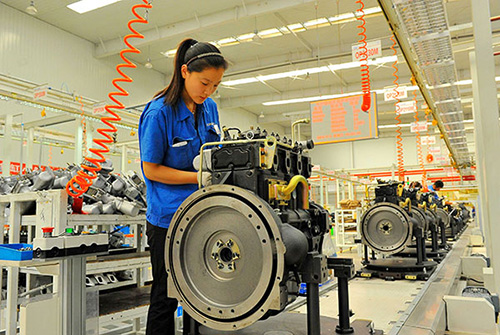
Hanvon Technology Co Ltd shows its facial-identification door-control system at a security product show in Las Vegas. A Chinese senior commerce official said on Tuesday that China and the United States should be more "open and tolerant" toward each other and work to improve and promote bilateral trade and investment. [Photo/Xinhua] |
Delivering a keynote speech at the 2012 China-US Economic and Trade Cooperation Forum in Beijing on Tuesday, Wang urged the two sides to "resolve their conflicts through cooperation, and avoid politicizing bilateral economic and trade issues".
He said both sides should jointly deal with the challenges ahead, expand common interests and enhance cooperation, reminding delegates that "dialogue and cooperation" have been the mainstays of China-US relations.

"China and the US are not competitors," he said, "but partners for mutual benefit."
His comments came as the world's top two economies remain embroiled in a series of trade and investment conflicts, involving most notably rare earth supplies and pricing, trade in solar panels, and exchange rates.
In March, the US together with the European Union and Japan brought China before the World Trade Organization over its policy on rare earth exports.
Six US solar panel manufacturers have accused Chinese companies of selling panels in the US market at prices below their costs, and in May, the US announced anti-dumping duties on Chinese solar equipment makers ranging from 31 percent to 250 percent, which has also sparked an EU enquiry into the Chinese solar panel industry.
Meanwhile, some members of the US Congress continue to protest that China has undervalued its currency against the dollar, making Chinese goods cheaper in the US and American products more expensive in China.
US Treasury Undersecretary Lael Brainard said on Monday that China's currency remains undervalued, and that Washington will continue to press the issue with its counterparts in Beijing.
"We sincerely hope that everyone could objectively and rationally cope with the issues between the two sides," added Wang.
"China and the US need to create an equal and fair business climate for companies."
He urged both sides to implement plans for better trade and investment cooperation.
Huo Jianguo, president of the Chinese Academy of International Trade and Economic Cooperation affiliated to the ministry, said that due to the timing of the US presidential election, some bilateral economic and trade issues have become too entwined with sensitive political concerns.
"The two sides should jointly seek cooperation on a wide range of sectors, looking at the longer term, rather than getting involved in short-term conflicts and politicizing economic issues," said Huo.
China and the US are the second-largest trade partners of each other. In 2011, bilateral trade reached $446.7 billion, 180 times greater than when the two sides established diplomatic relations in 1979.
China has, for 11 years, been the fastest growing export market for the US, with China's imports from the US growing to $122.2 billion in 2011.
"There are far more common interests than conflicts between the two sides," added Wu Jianmin, secretary-general of the China Institute of Innovation and Development Strategy.
He suggested China and the US enhance cooperation in investment, particularly among small and medium-sized enterprises, and in innovative industries.
By the end of 2011, cumulative US investment in China reached $67.6 billion, accounting for less than 1 percent of total foreign direct investment in China.
Cumulative direct investment in the US by Chinese companies was more than $6 billion by 2011, making up for 0.5 percent of the US' total.
"The two-way investment scale is comparatively small," said Zheng Bijian, president of the China Institute of Innovation and Development Strategy, meaning there is "huge potential for closer ties".
China's outbound direct investment in the US has been on the rise since the outbreak of the eurozone crisis, rising 27 per cent year-on-year in 2011.
"Chinese investment in the US is good for the US economy, for integration between the two economies, and for Chinese firms," added Ted Dean, chairman of the American Chamber of Commerce in China.
As eurozone debt woes spread to more member nations, the International Monetary Fund in July lowered the global economic forecast for this year and the next.
The US remains troubled by high unemployment and is expected to launch a third round of quantitative easing, while in China, economic expansion slowed to 7.6 percent from April to June, the slowest pace in three years. Some experts warn the economy is yet to bottom out.
As part of its 12th Five-Year Plan (2011-15), the Chinese government is accelerating the transformation of its economic growth model, developing strategically emerging industries.
And the nation has also vowed to expand domestic consumption, with imports expected to reach $10 trillion during the period.
Wang Chao added that the two countries continue to face difficulties and risks amid the stalling global economy. "They need to deal with these challenges jointly."
Contact the writer at dingqingfen@chinadaily.com.cn

Copyright 1995 - . All rights reserved. The content (including but not limited to text, photo, multimedia information, etc) published in this site belongs to China Daily Information Co (CDIC). Without written authorization from CDIC, such content shall not be republished or used in any form. Note: Browsers with 1024*768 or higher resolution are suggested for this site.
License for publishing multimedia online 0108263 Registration Number: 130349