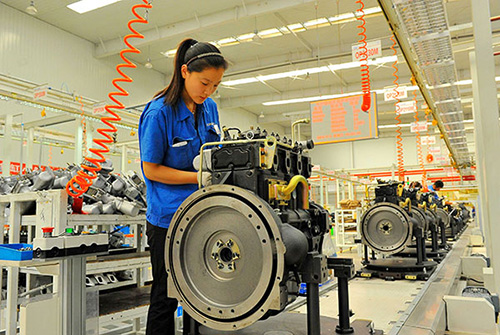
China needs to enhance vocational education in order to end the oversupply of university graduates and the shortage of technicians, said a senior labor official.
"The education system should suit the demands of the labor market as the economy develops. More resources should be put toward vocational education," Wu Daohuai, director of the department of vocational skills development under the Ministry of Human Resources and Social Security, told China Daily.
 |
|
A teacher (left) instructs vehicle maintenance and repair students at Licheng No 2 Occupational Middle School in Jinan, East China's Shandong province, in May. Zheng Tao / for China Daily |
Wu said the country’s education system has been focused on higher education in recent years, which has led to a fast growth in the number of university graduates.
"Such a move encourages young people to go to college, and so fewer choose to go to vocational schools," he said.
Many Chinese universities emphasize teaching theoretical knowledge rather than useful skills, he said, and a lot of students believe they are entitled to white-collar jobs after graduation and they never consider becoming blue-collar workers.
Labor authorities in Zhengzhou, capital of Central China’s Henan province, released a report in July showing that only 15,000 out of 70,000 university graduates obtained a job even though more than 90,000 positions were available at local job fairs this year.
Many graduates prefer to take low-income white-collar jobs rather than high-income blue-collar work, the report showed.
The employment outlook for university graduates is tougher now because 200,000 more graduates are expected to leave school this year.
Wu said the current system has led to a huge waste of labor resources.
"We should make becoming a technician more attractive to youths, with more favorable policies and incentives to encourage young people to learn skills and do technical work," he said.
The government will allocate more funding to support the development of vocational schools, he said.
According to the Ministry of Education, the country aims to set up a modern vocational education system by 2015. About 22 million people received vocational education last year, official figures showed.
Some young people have already started to seriously think about which direction their futures lie.
Zhou Hao, 22, studied life sciences at Peking University in 2008 but transferred to Beijing Industrial Technician College in 2010.
"I disliked the major in the university, and the ideal job in my mind is one where I can make real products with my hands," he said.
Zhou is interested in computer-based mechanical operation, and students in his college can usually find good jobs after graduation.
"My parents opposed my quitting the university, but I finally convinced them because I believe someone — no matter if he takes vocational or university studies — should not take a real white-collar job right after graduation," he said. "All people would start work from the grassroots."
Xia Mo, 22, who also studies at Beijing Industrial Technician College, said his school signs contracts with many enterprises so students do not need to worry about jobs.
"Many graduates go to work in companies such as Siemens and Cummins as technicians with starting salaries from 3,000 to 5,000 yuan ($470 to $790) a month," he said.
"Many of my schoolmates in middle schools who went to universities and graduated this year even envy me because it is not easy right now for someone with only a bachelor’s degree to find a job."
The average monthly starting salary of Chinese university students who graduated in 2011 was 2,700 yuan, and nearly 70 percent of them earned a starting salary less than 2,000 yuan, according to a recent report by Tsinghua University.
chenxin1@chinadaily.com.cn

Copyright 1995 - . All rights reserved. The content (including but not limited to text, photo, multimedia information, etc) published in this site belongs to China Daily Information Co (CDIC). Without written authorization from CDIC, such content shall not be republished or used in any form. Note: Browsers with 1024*768 or higher resolution are suggested for this site.
License for publishing multimedia online 0108263 Registration Number: 130349