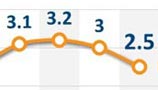
The WTO's latest forecast for global trade growth has had to be revised sharply downwards - from 3.7 percent of total trade volume in its April forecast to 2.5 percent this year. Lamy considers that "pretty severe" and blames it squarely on the continuing crisis in the euro zone, weak job and growth figures in the US, and a slowing Chinese economy.
He is that rare blend, a philosopher who is also a pragmatist. He avows free trade as the most immediate and effective way to lift billions of people out of abject poverty with the same fervor that he enforces the WTO's many rules against its member countries which step out of line.
The plain fact, he muses, is that opening one's markets to the world is "painful" because it makes one have to compete more fiercely with others for jobs and business, which inevitably means that some win big, while many others lose.
The biggest winner of all, he says, is the consumer, but, as Lamy notes, very often, they don't know why they have won.
"If your food or T-shirt is 30 percent cheaper than it was a few years ago, you don't find on your food or T-shirt label the words, 'This is thanks to the WTO'."
Lamy, who was trade commissioner of the European Commission for five years, became WTO chief in 2005. He will remain so until next year, after which he is tipped to become France's next finance minister. Asked about that, Lamy said he did not answer "What if?" questions.
Those who know the Frenchman call him tenacious, obstinate even, which they say comes from his hobby of running marathons. "He simply does not give up," said trade economist and RSIS associate don Pradumna Rana, 65, in a later interview.
But shouldn't even the most determined person call the Doha Round of trade talks, which have been stalled since 2001, a dead horse, and begin a fresh chapter in world trade negotiations?
After all, doing so would not dent the WTO's good work thus far, which has included giving technical assistance to developing countries so that they can hone the skills of their people to work to world-class standards, compete with the best, and in so doing, prosper.
But Lamy insists: "International negotiations never die!"
"The notion that we should forget about Doha doesn't make sense politically because many of the questions that were originally on the Doha agenda are still questions for today and tomorrow. You cannot forget about trade-distorting farm subsidies, or peak tariffs, or ocean-depleting fishery subsidies."
The way out, he says, is for the WTO to adjust its many stringent rules to suit changing circumstances. "But that will take time," he says.
Prof Rana says that, to begin with, the 17-year-old Geneva-based global trade club should do away with the requirement that all its members agree to agree, otherwise their talks will always be at an impasse. Also, he adds, the WTO should allow its members to choose whether or not to take part in certain negotiations, otherwise some might take advantage of the "all for one and one for all" situation to put talks off.
Countries, in general, covet WTO membership because it opens their products, and some services, immediately to most countries whose markets they would otherwise not have access to. This can boost jobs and incomes.
But the Doha Round of talks broke down after many WTO member countries - chief among them the US and India - could not agree on doing away with farm subsidies. Subsidies are considered an unfair trade practice because subsidized farmers can sell their produce cheaper, undercutting farmers without such subsidies.
The 11-year-old Doha deadlock has since led many WTO members to sign bilateral free trade agreements (FTAs) with each other, or with smaller groupings of countries. That tangled web of FTAs, says Prof Rana, is like "poison ivy" snaking around the WTO's truly international, multilateral system of promoting trade, as well as adjudicating trade disputes.
But Lamy says the stalled trade talks are really a reflection of how slowly all countries are adjusting to the new world order, which puts China front and center for the future. It is a case of how current powers, like the US and Europe, are trying to cope with, or deny, the shift in balance.
"In a way," he says, "we've been a victim of this difficulty to adjust to this rebalancing of the planet, in terms of how it translates into rights and obligations of members in an international system like the WTO."

Copyright 1995 - . All rights reserved. The content (including but not limited to text, photo, multimedia information, etc) published in this site belongs to China Daily Information Co (CDIC). Without written authorization from CDIC, such content shall not be republished or used in any form. Note: Browsers with 1024*768 or higher resolution are suggested for this site.
License for publishing multimedia online 0108263 Registration Number: 130349