Urbanization drive
Besides economic growth and capital investment, there is also a strong demand for property due to rapid urbanization in China.
According to a study conducted by the Chinese Academy of Social Sciences, China's urbanization is expected to reach 75 percent by about 2040, which means that more than 14 million people will move to cities every year over the next 30 years.
"The real estate sector will have a lot of opportunities for development during the next 30 years of further urbanization," says Chen Huai, director of the Institute of Urban-Rural Development of China.
Dong from Insight Investment says that the Chinese realty market is quite comprehensive but complicated and full of opportunities and challenges. "It is definitely not a dying market or a bursting bubble."
Challenges ahead
After decades of high-speed development, the property sector is now transforming to a higher-level market-oriented economy. This process will lead to structural adjustments in all Chinese cities as well as further market liberalization, says Chen from the Institute of Urban-Rural Development of China.
"The Chinese realty industry entered the third level of market development with property rights, but skipped the process of marketing production factors, including land and capital," Chen says, adding that a more liberalized realty market can exert a bigger influence.
According to Chen, most developers in China are concerned about the current controls on the sector. Of the 297 major Chinese cities, only about 40 have restrictions on property purchase, or in other words, 17 percent of the total market.
"Developers hoping to make big profits from the third or fourth home buys by wealthy families in smaller Chinese cities are unrealistic," he says, adding that the second and third decades of Chinese urbanization should focus more on developing the second- and third-tier cities.
"As long as China does not have the urban development structure of mega, medium-sized and small cities, the housing price bubbles in the major cities will not be solved without government restrictions," Chen says.
Other than the 14 million people migrating to Chinese cities every year, the growth of the middle class is another force that is of immense cheer to the property sector.
Audrey Kaplan, senior portfolio manager at Federated Investors Inc, a US-based financial services company, said in a recent article that the upper-mid to high-end level of the Chinese housing market, where demand is soaring along with the Chinese middle class, is projected to add 250 million households over the next eight years.
"That is equivalent to 750 million people, or roughly 2.5 times larger than the entire US population. And these households don't just want homes. They want cars, clothes and other goodies too," she says.
"Residential development should not only focus on the quantity but also on the quality of supply," says Dong from Insight Investment. "Developers and local governments should pay more attention on how to improve the overall living environment with more public schools, hospitals, public transport and other facilities in local communities."
Commercial sense
The government curbs on residential property have prompted many foreign investors to instead park their money in commercial realty, a sector that is slowly gaining ground.
|
 |
According to Alan Liu, managing director for North Asia at Colliers International, a global real estate services company, most of the developers and investors want stable income. The stable income in this case comes from more rentals and hence most of them are adding more commercial realty to their portfolios.
"In many advanced markets like Singapore, there are more commercial realty owners than residential landlords. That's the global trend. China will also go to the same way and we will see more developers going for single ownership, rather than selling by floors. They want to retain more rental income," Liu says.
Investment in Chinese commercial properties increased 55 percent in the second quarter of 2012, compared with the figure in the first three months of this year, Xinhua News Agency said in a recent report.
"Due to the government curbs on real estate purchases, commercial and industrial property is becoming more appealing to investors," says Lin Bo, director of the research center under the China Real Estate Corporation.
According to Lin, though there is an oversupply of property in some cities, the rapid urbanization will erase the phenomenon over the next few years, while in the commercial sector, investors should do enough market research before making a decision to avoid the oversupply.
"The oversupply in the commercial sector is something that cannot be easily solved in the short term," Lin says.
Analysts from global realtors Jones Lang LaSalle are often asked if there is too much retail supply in China, because development tends to occur ahead of demand.
"The good news is that at the aggregate level, there is not too much supply," says Steven McCord, director of research at Jones Lang LaSalle's China branch.
The total retail stock in China's top 20 markets will grow at the same speed as the consumer class population, as defined by income. Therefore, at the macro level, the supplies are appropriate, McCord says.
"However, risks lie in individual submarkets where you may find too many shopping centers appearing within close proximity to one another - this is where saturation may occur," he says.
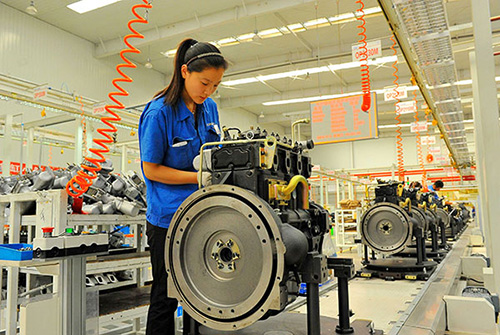
Like commercial property, industrial property is also gaining in demand. "We will see a lot of interest in Chinese industrial property, especially after the nation moves up the value chain and starts producing more high-quality and high-value products," says Ben Chaston country director of global construction consultancy Turner & Townsend (Shanghai) Co Ltd, Beijing branch.
zhaoyanrong@chinadaily.com.cn


Copyright 1995 - . All rights reserved. The content (including but not limited to text, photo, multimedia information, etc) published in this site belongs to China Daily Information Co (CDIC). Without written authorization from CDIC, such content shall not be republished or used in any form. Note: Browsers with 1024*768 or higher resolution are suggested for this site.
License for publishing multimedia online 0108263 Registration Number: 130349