BEIJING - Although the Chinese economy has shown strong signs of stabilizing, the key Shanghai stock index opened at its lowest point in nearly four years on Thursday.
Experts have attributed the paradox mainly to an imbalance in supply and demand on the stock market, a seasonal cash crunch toward the year's end and systemic flaws that make it difficult for the stock market to fully reflect the economy.
The benchmark Shanghai Composite Index slid 0.89 percent to end at 1,973.52 on Wednesday, the lowest level since January 19, 2009.
Chinese stocks opened even lower on Thursday, with the benchmark Shanghai Composite Index opening at 1,972.93, down 0.03 percent from the previous close.
Stocks and gap tell different stories
The Shanghai Composite Index opened at a nearly four-year low despite China's fast-growing economy, surging consumer affluence and rising global clout that has been hard for investors to ignore recently.
The Shanghai index has tumbled 43 percent over the past three years and is down 64 percent from its peak in early 2008, according to media reports.
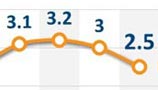
Although China's economy grew by 7.4 percent year-on-year in the third quarter of 2012, slowing for the seventh consecutive quarter and down from 7.6 percent in the second quarter and 8.1 percent in the first, it is still leading the world's economies in terms of gross domestic product growth.
The growth rate of China, the world's second-largest economy, is expanding by about four times that of the United States.
China set its annual growth target at 7.5 percent this year. The National Development and Reform Commission, China's top economic planner, said on the sidelines of the national congress held earlier this month that the country is on track to achieve this target.
The HSBC said earlier this month that its Flash China Manufacturing Purchasing Managers' Index bounced back to expansionary territory for the first time in 13 months to stand at 50.4 in November, indicating that the Chinese economy is gaining momentum.
What's hebind the market retreat?
China's stocks are not just "a bear market," said Hua Sheng, a well-known Chinese economist, noting that the problems lie mainly in an apparent imbalance between supply and demand as well as in the basic market system.
In regards to the recent tumble, other analysts have also cited a weak outlook for corporate earnings and an expected seasonal cash crunch toward the year's end.
It seems strange that a number of enterprises are lining up to enter the Chinese stock market despite its bearish performance and many investors waiting for their chance to cash out, said Hua, the economist.
Investors have been jittery about a growing number of companies waiting to get a greenlight to list, which would further strain market liquidity.
According to data from the China Securities Regulatory Commission, a total of 808 companies were applying to launch initial public offerings as of Nov 22 this year, with a gross fundraising volume of more than 500 billion yuan ($80 billion).
When the supply of shares exceeds demand, the price will decline -- music that must be faced by both the regulator and investors, Hua noted.
One efficient way to resolve the imbalance is to lift the threshold for listing, said Hua, adding that market entrance standards should be made by taking both the profit and the scale of enterprises into consideration, while companies that have a tendency to blindly restructure assets after listing should be restricted.
As China's main stock market continues to fall, fewer companies have been permitted to launch IPOs. A total of 105 companies went public in the first half of this year, but the number of IPOs has dropped sharply to 50 so far in the second half of the year.
"The good days have passed for Chinese investors who have long looked to IPOs as a decent investment that could provide outsized returns to lift portfolios," said an investor surnamed Cao.
"Systemic flaws, such as a less market-oriented IPO mechanism, make it hard for the stock market to fully reflect a rebound in the economy," Zhang Gang, an analyst at Central China Securities, said, as quoted by the Wall Street Journal.


Copyright 1995 - . All rights reserved. The content (including but not limited to text, photo, multimedia information, etc) published in this site belongs to China Daily Information Co (CDIC). Without written authorization from CDIC, such content shall not be republished or used in any form. Note: Browsers with 1024*768 or higher resolution are suggested for this site.
License for publishing multimedia online 0108263 Registration Number: 130349