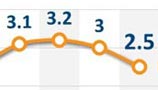
With the global economy in a ditch, China's private equity and venture capital industry, like many other sectors, have taken a continuous dive since the late 2011.
Statistics went straight down - funds raised, deals invested, gains realized, etc. While the sector made red-hot gains in 2010, that tide has since crested. Over the next few years, we will see among the companies in this sector just exactly who will be swimming naked.
What has happened since 2011 has been unavoidable, but understandable. Since the days of boom, economic conditions for the PE and VC sectors have worsened, competition has been fierce and evolution has taken place rapidly. Let's take a quick look.
All three kinds of active general partners in China are facing challenges to their fundraising efforts. The limited partners of offshore funds are facing liquidity issues across the board with a volatile global economy. With many similar things in their portfolio but no buyers, it is a tough call for them to commit new PE and VC investments.
The state-sponsored general partners are often tied to state enterprises or local governments, but many local governments have been battered due to falling prices for land and a shrinking stream of corporate tax revenue. The bright spots, however, are the few GPs who are supported by large State-owned enterprises that can still obtain their funding from previously agreed terms.
Privately owned GPs are fighting hard for the remaining LPs. Most of them are high net-worth individuals or private companies, that in turn are also suffering from a drop in real estate, stock and asset prices as well as dwindling business cash flow.
The lack of domestic institutional LPs, who are long-term, stable and investing in China's PE and VC sectors, certainly will not help the situation. The endowment funds have not yet developed and insurance companies are taking a very cautious step, with support mostly for state-sponsored GPs.
If fundraising is one problem in the entire chain, exit is certainly no small issue.
In both 2010 and 2011, the number of Chinese companies that went public exceeded 300, the highest in the world. That number was halved by 2012, with more than 800 companies still waiting to go through their IPO application process. Moreover, it is estimated that at least one-third of them will be asked to leave during the process due to falling revenue and profits. That puts pressure on GPs' fund performance and LPs' willingness to fund the GP. And the vicious cycle goes on.
Chinese GPs must now work harder to find new exit routes for their portfolio companies, mainly through mergers and acquisitions or buybacks, which demand a greater level of expertise and more resources.
Over the years, some domestic GPs have built good relationships with domestic companies, many of whom could be potential M&A buyers. But if GPs do not demonstrate that there are benefits to an M&A deal, these potential buyers could be hesitant to write the check. Offshore GPs do not currently have greater advantages in wooing buyers for M&A deals because international buyers are facing liquidity issues and declining economies around the world.
Today, Chinese buyers have a greater appetite for overseas targets, with support from the Chinese government and China's financial institutions.
Some GPs are pushing for earlier stage deals in the hopes of hitting the jackpot. And the rule of the thumb is the earlier the deal is done, the higher the uncertainties. One may be lucky to hit a jackpot once or twice, but no GP's long-term success is built on that kind of luck.
Many Chinese GPs have formed within the last three to five years and these new GPs simply do not have the expertise to perform these demanding tasks. There are some experienced GPs, however, working closely with their existing portfolio companies, building early stage companies in the sectors in which they already have strong expertise and deep resources.
High returns only reward those who are prepared and those with resources to really help early stage companies survive and grow. This is the same whether a GP runs a renminbi fund or an offshore fund.
Just like in the United States and Europe, only a small percentage of Chinese GPs will survive and prosper. What is different this time is that the cycle is running at a much higher speed. GPs who stand tall in the end will reap high profits from the sector and reward their limited partners. Just don't pick the wrong dragon.
The author is executive vice-president of Shenzhen Co-win Venture Capital Investment Ltd.


Copyright 1995 - . All rights reserved. The content (including but not limited to text, photo, multimedia information, etc) published in this site belongs to China Daily Information Co (CDIC). Without written authorization from CDIC, such content shall not be republished or used in any form. Note: Browsers with 1024*768 or higher resolution are suggested for this site.
License for publishing multimedia online 0108263 Registration Number: 130349