Wealthiest man tells how to rein in rocketing house prices


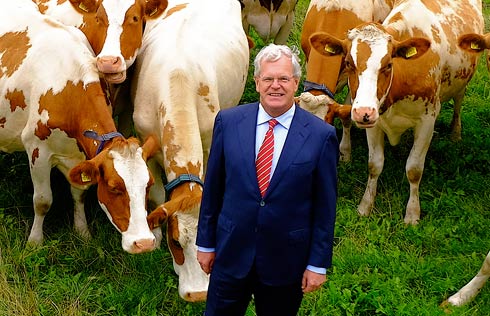
The Chinese mainland's richest man has called for the reduction of land prices and the scrapping of taxes and fees tied to real estate transactions, in order to rein in rocketing house prices.
Zong Qinghou, chairman of Hangzhou Wahaha Group Co, the country's largest beverage company, told China Daily that high property prices had become the most disruptive factor in society.
"Based on current house prices and average wages, young working people, especially in large cities, would never be able to afford to buy their own home," Zong said.
He suggested land sale revenues should not be used as fiscal revenue by local governments, which would rein in their urge for relentless urbanization.
China's local governments, which acquire land at the acquisition price and sell it at the market price, have come to rely heavily on land acquisition as a revenue earner to finance the delivery of public services, especially infrastructure, according to a World Bank report.
Zong proposed the elimination of taxes and fees related to real estate transactions, which he said account for half the cost of a house.
Of the 18 types of taxes levied in China, 10 are related to the land and property market.
Five kinds of taxes levied on the property market contributed 1 trillion yuan ($160 billion) to governments in China in 2012, up from 90 billion yuan in 2003, an increase of more than 1,000 percent.
Citing a senior executive of realty developer Shanghai Pengxin Group Co Ltd, Beijing-based newspaper China Times reported that the taxes and fees collected by governments accounted for 20 to 30 percent of house prices.
Combined with a 30 percent land transfer fee, local governments could collect at least 1 million yuan from a 2 million yuan house.
Zong's vision even includes a bold measure to ensure more city dwellers have the right to public housing.
According to Zong, public housing could be offered to city residents in the following categories: young people who have just started work, who would be entitled to a unit of housing available at a rent of no more than 10 percent of their monthly salary; and people starting a family, who would entitled to a unit of public housing at a mortgage less than 20 percent of their monthly income.
Meanwhile, high-income earners would be able to purchase an unlimited number of homes, but be prevented from obtaining bank loans for this purpose.
"People who had previously purchased a house at a high price should get reasonable compensation," Zong added.
Ni Pengfei, director of the Urban and Property Research Center under the Chinese Academy of Social Sciences, said the chances of fully socializing the housing sector are slim as it is a major driving force of China's economy.
Investment in China's housing industry accounts for around half of the nation's total investment and is related to more than 20 industries in China.
"The key problem is that developers are hyping up the prospects of further house price rises, which triggers panic purchasing," Ni said.
The strong rebound in the property market since June 2012 led to a central government response on March 1 that targeted speculative property sellers.
Homeowners who sell their homes within five years of their purchase will face capital gains tax of 20 percent. Before the new measure, the tax levied was 1 percent of the sale price.
The measure targeting speculation, however, resulted in further price hikes in the new housing market, especially in key cities as buyers opted for new properties.
In February, of the 70 major cities monitored by the National Bureau of Statistics, 66 saw house prices rise month-on-month, compared to 53 in January.
"In the current property market in which demand outweighs supply, a tax on the transaction sector could only push up the house prices," said Ni Hongri, a research fellow with the Development Research Center under the State Council.
zhengyangpeng@chinadaily.com.cn