Authorities should be aware of the risks and make timely moves to prevent it causing systematic economic collapse
Signs have emerged that the curtain is falling on the decade-long golden period for China's real estate.
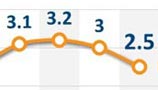
The average price of newly built homes in China's 70 major cities rose 8.7 percent year-on-year in February, slightly lower than the 9 percent growth in January, according to data from the National Bureau of Statistics. Compared with 62 cities that saw a price rise in January, the number decreased to 57 in February and the margin of the average price rise declined from 1.2 percent month-on-month to 0.7 percent. The rise in the average house price in Beijing, Shanghai, Guangzhou and Shenzhen, the four first-tier cities that witnessed a frenetic price rise in 2013, fell below 20 percent year-on-year.
 |
|
 |
Some recent negative news on the housing sector has caused market worries. Vanke, a leading real estate developer in China, recently brought to the market one of its residential developments in the south of Beijing at an average 21,000 yuan ($3,387) per square meter, far below the previously anticipated 26,000 yuan. As the weather vane of China's housing prices, the price decline in Beijing is seen as signaling a possible price decline across the country and strikes a psychological blow to those holding an optimistic outlook on home prices. The collapse of the fund chain recently reported about a developer in Zhejiang province has further aggravated pessimism over the prospect of the rosy housing market. The drastic fall of the yuan's exchange rate against the dollar in February has also caused widespread concerns over the negative impacts caused by the possible exodus of international capital from the Chinese housing market.
There is no doubt that a chilly autumn is coming for China's housing market. Many analysts had previously concluded that there will be at least another 10 years of golden time for the market. Qiu Baoxing, vice-minister of housing and urban-rural development, said on the sidelines of the annual sessions of the top legislature and top advisory body that China's housing sector will unlikely encounter a big crisis in 10 years, citing enormous housing demand from an additional 300 million Chinese people who will move to urban areas or whose urban homes will be rebuilt or renovated. It is believed by many that the housing market will still be China's fastest-growing sector before the end of its urbanization. Compared with such a view, some are more wary, but they still hold an optimistic outlook on the housing markets of first-tier and provincial capital cities. However, the lackluster price rises in Beijing and other first-tier cities in recent months and their slackened sales mean that the prospect for China's housing market is not that optimistic.
The slowed price rises and the drastic drop in sales this year have taken place at a time when no explicit housing regulations are being formulated. The government even refrained from taking administrative measures after the housing market experienced an unreasonable price rise in 2013, to leave the settlement of the price issue to the market. This also proves the recent deceleration of home price rises is largely a kind of market trend.
A series of factors, including a loose monetary policy, strong housing demand and supply insufficiency, its high-speed economic development, local governments' excessive dependence of their fiscal revenues on land sales, as well as the influx of international capital betting on the yuan's appreciation, have altogether bolstered the soaring of domestic home prices over the past decades. However, all these engines have started losing power since the start of 2014. The confirmed phasing out of the years-long quantitative easing policy by the US Federal Reserve will inevitably accelerate the outflow of international capital from China. The country's irreversible economic deceleration in the years ahead, increased efforts to build government-subsidized lower-price homes as well as recent yuan's depreciations will also weaken the previous dynamics for home price rises.
The combined influence of these factors has increased the possibility of a decline in house prices this year. The fast price rises following a series of stimulus measures adopted after the 2008 global financial crisis have tightly bound China's economy to the housing market. Thus, a housing market collapse will inevitably be a drag on the whole national economy. China's fragile economic growth model and its per capita income, which is far below the world's average, also decide that the drastic fall of home prices will cause much fiercer negative effects to its economic and financial system and people's living conditions than those to Japan in the 1980s.
The year of 2008 offered the best time for China to prick its real estate bubbles, but it failed to do so. The country will have to endure much more serious negative effects if it now takes such action. The only option ahead for the Chinese government is that it should change the current real estate regulatory policy, from how to curb home price rises to how to prevent their decline from sparking a systematic economic collapse, and seek more time for efforts to reduce the impact of the busting housing bubbles.
The author, a member of the 12th Beijing Municipal Committee of the Chinese People's Political Consultative Conference, is director of the Private Economy Research Center under Renmin University of China.

Copyright 1995 - . All rights reserved. The content (including but not limited to text, photo, multimedia information, etc) published in this site belongs to China Daily Information Co (CDIC). Without written authorization from CDIC, such content shall not be republished or used in any form. Note: Browsers with 1024*768 or higher resolution are suggested for this site.
License for publishing multimedia online 0108263 Registration Number: 20100000002731