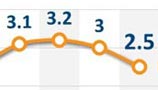
Chinese government seems less willing than its predecessor to cut the reserve requirement ratio (RRR), but how long can it resist?
There is a strong argument for easier monetary policy. The People's Bank of China, or PBOC, already appears to have lowered interbank rates, which should boost bond issuance and discounting of bankers' accepted drafts. This policy easing has been conducted without any official signal. But growth is going to get weaker in Q3 and clear evidence that Beijing is moving to stabilize the economy will become more important. You cannot deleverage an economy which is not growing.
From June 2008 to September the same year, the RRR was reduced by a total of 250bps. This was in response to the global financial crisis and a collapse in external demand – a clear emergency. But between January 2010 and June 2011, the RRR for large financial institutions was raised to 21.5 percent. The central bank later cut RRR in December 2011, February 2012 and May 2012 by a total of 150bps. This move was more similar to today's situation, coinciding with a slowdown in industrial activity and housing. We have assembled several key economic indicators, including industrial value-added growth, electricity growth and interbank liquidity,to show what was happening when the RRR was cut in 2008 and 2011.
Industrial value-added (IVA) growth. It collapsed in September 2008. The late-2011 RRR cut also took place at a time of slowing IVA growth. Today, IVA growth is slow but stable, according to the official numbers. The current level of IVA growth is consistent with a RRR cut, but it is not (officially) decelerating, which weakens the case for a cut.
Electricity growth. Electricity production is one reliable way to check the accuracy of industrial activity data (if you worry that the IVA numbers might be exaggerated). Electricity production growth is slowing to a level similar to the time of the 2008 RRR cut; it is well below the growth rate at the time of the 2011 RRR cut.
Credit growth. As is shown in our in-house measure, credit growth decelerated to 17 percent year–on-year from 22 percent during the 2008 RRR-cutting cycle, and to around 15-17 percent from 25 percent in 2011.
Interbank liquidity. Do high interbank rates (i.e., tight interbank liquidity) cause the PBOC to cut the RRR? It seems not. In 2008, the 7-day repo rate was around 3.0-3.5 percent at the time of the first RRR cut; it did not initially react to the first cut, though it fell to 1 percent following a sharper reduction. The situation was a little different in 2011, when yields were relatively high, at around 4 percent. Again, the RRR cut did not immediately have a big effect on liquidity, but the 7-day repo rate did ease to 3.0-3.5 percent.
At present, the 7-day repo rate is trading below its level at the time of the 2011 RRR cut, and above the level at the time of the 2008 cut. We conclude that interbank liquidity is not particularly tight (the result of PBOC monetary policy loosening already implemented), but is at a level where a RRR cut is possible.
Real interest rates. As inflation has fallen, real bank loan rates have risen. This is a problem because high real interest rates raise borrowing costs. Despite the elimination of administrative controls on lending rates, de facto bank loan rates tend to be quite sticky and still do not react to rises and falls in interbank rates. With nominal corporate sales growth still lackluster, a high real interest rate is a problem. In such an environment, debt burdens can easily rise rather than fall.
Corporate profits. In previous RRR cutting cycles, corporate profit growth was running at around 20 percent and was decelerating sharply. Today, profit growth is at a much weaker level but appears directionless. With profit growth at around zero percent, the time appears right to lighten corporates' burden by easing policy. Paying a real interest rate of 6 percent in an environment of such sluggish profit growth is likely to translate into weak corporate investment.
Housing sales growth. Given the importance of residential housing to China's economy, and the high leverage of developers, housing activity indicators are worth looking at. In 2008, housing sales growth had just turned negative when the PBOC cut the RRR; in 2011, sales were just about to enter negative year-on-year territory.
Home prices. Prices of new homes appear to be stabilizing – but are still rising on a year-on-year basis, according to official price data. The data does not capture informal discounts offered by developers who prefer to keep their top-line sales price stable. In 2008 and 2011, in contrast, home prices were around six months into a deceleration phase when the RRR was cut.
Most of the above indicators suggest that if Beijing's reaction function were the same as before, the RRR would have already been cut. Premier Li is to be congratulated for changing the framework of monetary policy to accept slower growth.
That said, we think Beijing can walk and chew gum at the same time – i.e., both push through reforms and ease monetary policy to support growth. The economy is set to slow further this year given the downdraft caused by the real-estate sector, high real interest rates and very low profit growth. Structural reforms are unlikely to deliver a meaningful growth dividend, and there is limited room to ease via the exchange rate.
The author is head of Greater China Research at Standard Chartered Bank. The views do not necessarily reflect those of China Daily.

Copyright 1995 - . All rights reserved. The content (including but not limited to text, photo, multimedia information, etc) published in this site belongs to China Daily Information Co (CDIC). Without written authorization from CDIC, such content shall not be republished or used in any form. Note: Browsers with 1024*768 or higher resolution are suggested for this site.
License for publishing multimedia online 0108263 Registration Number: 20100000002731