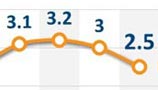
The Gini coefficient, a widely used measure of inequality, has increased from 0.39 to 0.46 in developing Asia as a whole. A higher number represents more inequality, with a figure of 1 representing total inequality.
In the past 25 years, the Gini has risen from 0.29 to 0.38 in Indonesia. In Bangladesh, it has risen from 0.27 to 0.32 in the same period. Hong Kong, with a Gini of 0.54, has the widest income gap in Asia.
The problem is significant because greater inequality means that all the economic growth in the region over the past few decades has benefited a small minority far more than the vast majority at the bottom of the economic pyramid.
To ensure economies grow sustainably, policymakers have to promote inclusive growth as part of any fiscal plans. Governments have the option of directing more resources to meet inclusion targets but they may not have much time. Changing demographics and environmental concerns tend to cause greater inequality and both are moving in the wrong direction.
"Widening income gaps in developing Asia strengthen the case for government response," says Park Donghyun, principal economist with the Economics and Research Department at the ADB. "Making the growth process more inclusive is likely to require some expansion of public spending. But expanding public expenditure without adequate revenue mobilization can be unsustainable."
Park explains that the region's past growth boosted living standards and lifted millions out of poverty, but now widening inequality is undermining this success.
"International experience shows that public spending can reduce income inequality. For example, government spending on education and healthcare broadens access for the poor to these vital services and thus levels the playing field."
Education may be a key area of focus. More access to education facilitates more active participation in the economy.
 |
 |
| Top 10 most competitive countries and regions | Top 10 regions with highest GDP in China |

Copyright 1995 - . All rights reserved. The content (including but not limited to text, photo, multimedia information, etc) published in this site belongs to China Daily Information Co (CDIC). Without written authorization from CDIC, such content shall not be republished or used in any form. Note: Browsers with 1024*768 or higher resolution are suggested for this site.
License for publishing multimedia online 0108263 Registration Number: 20100000002731