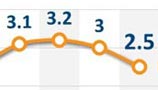
The pace of migration from rural areas to cities, a dynamic hailed by Li as key to the nation's development, is set to slow by one third in the years from 2013 to 2020 compared with the previous seven years, the government forecasts.
That's pressuring Li to find ways to optimize productivity. The rapid expansion of China's cities hasn't been accompanied by efficiency gains because of impediments including urban sprawl and inadequate infrastructure, according to Cui Li, a Hong Kong-based economist at Goldman Sachs Group Inc.
Achieving the same efficiencies as US cities, which are modest compared to those in more compact European metropolises, could add 1 percentage point to annual growth by the end of the decade, she estimates.
An additional 4.2 million people can be added to Guangzhou and 5.3 million to Shenzhen if those cities had the same population density as Seoul, according to a March report by the World Bank and the State Council's Development Research Center.
Making changes to land use that would spur denser cities could save China $1.4 trillion from a projected $5.3 trillion in infrastructure-spending needs during next 15 years, World Bank chief operating officer Sri Mulyani Indrawati said.
There are signs of progress. A rapid-transit bus system that opened in Guangzhou in 2010 has saved passengers a combined 32 million commuting hours a year and is projected to reduce carbon-dioxide emissions by 84,000 metric tons in its first decade of operation, the United Nations estimates. In Kunming, capital of southwestern Yunnan province, a new district is being developed with a subway system, bus stations and green spaces planned every 300 meters.
Building dense cities around mass-transit systems that balance commercial and residential areas would slash reliance on cars, according to the Energy Foundation, a San Francisco-based nonprofit organization that promotes clean energy. That would prevent as much as 800 million tons of carbon dioxide from spewing into the atmosphere by 2030, more than emitted by Germany in 2011, it estimates.
A continuation of old methods raises the specter of worsening traffic congestion and pollution in the biggest cities if migration continues to outpace policymakers' plans.
"For the last two to three decades, China's city planning has not taken migrants into account in their plans for transport, housing and many social services," said Kam Wing Chan, a professor at the University of Washington in Seattle and author of Cities With Invisible Walls: Reinterpreting Urbanization in Post-1949 China.
|
 |
 |
| Chinese premier stresses role of urbanization in economy | Protection of rural residents' rights in urbanization urged |

Copyright 1995 - . All rights reserved. The content (including but not limited to text, photo, multimedia information, etc) published in this site belongs to China Daily Information Co (CDIC). Without written authorization from CDIC, such content shall not be republished or used in any form. Note: Browsers with 1024*768 or higher resolution are suggested for this site.
License for publishing multimedia online 0108263 Registration Number: 20100000002731