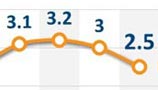
More sharply than ever, opinions are divided among Chinese economists as to how much growth China should strive for in the next year. Some are saying China's GDP growth rate can still be lower than this year's target of 7.5 percent. Others are saying a further slowdown could be dangerous and at the very least, the government should not deliberately use policies to seek slower growth.
From the pro-slowdown camp, several research papers are suggesting that Beijing should not fear even lower GDP growth rate than this year's target of 7.5 percent - so long as it can launch more reforms and cut down on more waste.
Unconfirmed information began spreading around earlier this month that the Central Economic Work Conference, scheduled every December to propose guidelines and targets, would aim for 7 percent or less in GDP growth, accompanied by further tightening of the money supply.
Earlier, domestic business reporters said they heard on different occasions high-level planning officials say there is "still room" for adjusting the economy to a slower mode. Probably just 7 percent for next year, said one paper quoting economists at the Chinese Academy of Social Sciences. A UBS forecast put China's growth rate at 6.8 percent next year and 6.5 percent in 2016, but said the slowdown still would not affect the country's general employment picture negatively.
At the same time, the resistance to further slowdown is apparently gathering power from a year ago, when local governments reportedly quit their GDP fetish and revised down local growth plans of their own accord.
One articulate critic is Shen Jianguang, Mizuho Securities (Asia) economist, who aired his concern two weeks ago that, now that China's reform and transition are unlikely to yield immediate results, if the decline in investment, in manufacturing and real estate continues, as it would appear, then China is stuck in a grave problem.
In an interview with China Business News, he said there would be two options for the government, either to use the slowdown to urge for more reforms, or to first stabilize economic growth above 7 percent before launching new reform initiatives. "I would vote for the latter," Shen said.
He said he is worried that once the economy goes downhill too quickly, the inertia would be hard to control. If the growth rate comes down too fast and too abruptly, and if it leads to a hard crash in the real estate industry, it would cause a disaster for many other industries. And if that happens, priorities would have to change. The government would be forced to come up with contingency measures just to restore the economy's everyday order and it would not be able to spare any resources for the reform's pilot projects in various places, Shen said. In the end, both growth and reform would suffer.
What Shen said did point out a crucial link, or where this economy is most fragile. Up to now, and it probably will remain like this for some time to come, China would to a great extent depend on one very volatile industry, namely the real estate industry, for its stability.
So, while a slowdown is theoretically a welcome phenomenon, which can help China shed its wasteful and uncompetitive industrial capacity, it really has to be managed with great care and expertise. Government officials, first of all Premier Li Keqiang, have pledged their effort to prevent a decline in real estate prices.
Temporary protection is necessary. Urban housing prices have been one of society's central concerns. In China, when it rises, it tends to rise wildly. And when it falls, it also tends to be akin to a free fall. Either way will upset many people. Indeed, the real estate industry tends to be a hotbed of problems. And more work is needed on the strategic level to create a stable and long-standing policy framework for the industry. Only that way can China be more confident in managing its economy's overall growth.
The author is editor-at-large of China Daily. Contact the writer at edzhang@chinadaily.com.cn
 |
 |
| Slowdown hammers growth at local level | The real importance of service |

Copyright 1995 - . All rights reserved. The content (including but not limited to text, photo, multimedia information, etc) published in this site belongs to China Daily Information Co (CDIC). Without written authorization from CDIC, such content shall not be republished or used in any form. Note: Browsers with 1024*768 or higher resolution are suggested for this site.
License for publishing multimedia online 0108263 Registration Number: 130349