Changes in roles of US, China raise friction in global financial markets
The two biggest tectonic plates of the world economy are shifting, setting off friction that is increasingly evident in financial markets and global capitals.
The United States is accelerating and China is cooling, a reversal of trends that followed the 2009 global financial crisis. As a result, oil is slumping as US supply rises and Chinese demand falls; capital is fleeing emerging markets; the dollar is surging and the influence of the big emerging markets is on the wane.
While the biggest losers are commodity producers and emerging markets, Russian President Vladimir Putin is proving the most exposed. His economy is headed for recession as the plunge in crude and the Russian currency deepen the impact of sanctions stemming from his aggressiveness in Ukraine.
"The shifts we're seeing in the global economy show the potential for unintended consequences and unforeseen tensions," said Lena Komileva, chief economist at G Plus Economics Ltd in London. "Emerging market vulnerability, headlined by Russia's crisis, could trigger more safe haven flows."
A strengthening US and slower China once topped the wish list of world leaders, who repeatedly expressed concern that the US was stagnating and China was overheating in the aftermath of the international recession.
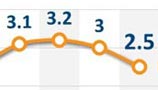
Their hopes are now being realized. China is on course to grow the least this year since 1990, as a slowdown in real estate investment continues and factories are shuttered.
Meantime, the US is gathering momentum with economists surveyed by Bloomberg News forecast a 2.9 percent GDP expansion next year, the fastest in a decade, as hiring accelerates and falling gasoline prices boost purchasing power.
"The deeper fundamental cause of all this is the prospect of a normalization of US monetary policy. Higher US interest rates are causing the rate advantage of risky assets to melt," said Ulrich Leuchtmann, a currency strategist at Commerzbank AG in Frankfurt.
A monthly survey by Bank of America Merrill Lynch found that fund managers increasingly favor the dollar and cash over risk assets and commodities.
Exhibit A for the new order is the price of oil, which has fallen about 45 percent this year, in part because of weaker Chinese demand and a supply glut deepened by US shale output.
US production has risen to 9.12 million barrels per day, the most in weekly Energy Information Administration data that started in January 1983.
Economists believe that the transfer of cash from energy producers to consumers is enough to boost the world economy. Berenberg Bank in London estimates current oil prices could boost demand by 1.5 percent of GDP in major economies in the next four to six quarters.
The results are nevertheless uneven. In a study of 44 nations, Oxford Economics Ltd listed Russia, Saudi Arabia, Norway, Italy and the Netherlands among the biggest losers from cheaper crude. Winners include the Philippines, China, India and Indonesia.
Money is flooding back into the US as the dollar gains in anticipation of higher interest rates. The dollar has jumped 9 percent on a trade-weighted basis this year.
In warning about the potential cost of a surging dollar, the Bank for International Settlements this month noted that international banks have loaned $3.1 trillion to nonfinancial companies in emerging markets, mainly in dollars, and that such nations have issued $2.6 trillion in foreign-denominated debt.
While a rising dollar could help beat back disinflation globally by enriching US consumers, currency strategists at HSBC Holdings Plc have warned that extreme strength would be a problem if Japan lost control of a weakening yen, a sliding euro raised fears of a breakup of the single currency or China tried to devalue the yuan.

Copyright 1995 - . All rights reserved. The content (including but not limited to text, photo, multimedia information, etc) published in this site belongs to China Daily Information Co (CDIC). Without written authorization from CDIC, such content shall not be republished or used in any form. Note: Browsers with 1024*768 or higher resolution are suggested for this site.
License for publishing multimedia online 0108263 Registration Number: 130349