Growth in fellow BRICS members and the new MINT bloc pale in comparison to that of China
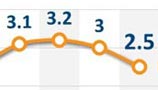
In early December, the Chinese government appeared to acknowledge publicly that the economy is set for a fairly prolonged period of relatively slower growth. Last year's GDP figures are expected to reach somewhere in the region of 7.5 percent and this year's growth forecast is closer still to 7 percent.
But this modest slowdown needs to be put into perspective and the benefits, such as more sustainable growth, need to be highlighted and appreciated by those dithering over potential or continued investment in the now supposedly fragile Chinese economy.
In so doing, a far clearer picture should emerge and point to the emerging market economy or economies where the smart money should be invested during 2015 and beyond.
It was economist Jim O'Neill who made a name for himself when he first coined and subsequently publicized and popularized the term BRIC back in 2001. BRIC, and later BRICS, supposedly represent a shift in global economic power from developed countries.
Brazil, Russia, India, China and South Africa were identified by O'Neill as countries to watch most closely as their economies advance rapidly and challenge the long-held dominance of the United States, Canada and the major European economies.
Despite China's recent and modest economic slowdown, its economy has motored at an incredible average growth rate of about 10 percent since O'Neil's BRIC proclamation.
It is with the other BRICS countries, therefore, where any sense of perspective should begin.
China is often compared most with its neighboring, burgeoning economic powerhouse India. The two countries are not only neighbors but also both have extremely large population.
Recently, the World Bank forecast the Indian economy to arrive at a growth rate of only 5.6 percent for last year and predicted GDP to reach 6.4 percent for this year. This is all that is expected despite renewed confidence in the Indian economy and high hopes as a result of a series of planned economic reforms by the new government.
In 2013, the Indian economy grew by only 5 percent.
China's growth rate this year can only spread envy across the Indian border with the expected gap remaining between the two rival economies.
Staying with O'Neil's BRICS set, the comparison becomes starker when the other member economies are compared directly with China.
The Brazilian government recently revised its target GDP growth rate for 2015 from 2 percent to a paltry 0.8 percent. What's worse, the Brazilian economy looks like it will be posting a pathetic 0.2 percent GDP growth rate for this year after entering recession during the first half of 2014. But the Brazilian government does foresee an economic pickup over the next few years with GDP for 2016 expected to grow to only 2 percent and only 2.3 percent in 2017. Surely the Brazilian government would kill for China's 7 to 7.5 percent growth rate.
Sadly, the gap becomes even greater when we turn to the remaining BRICS countries, Russia and South Africa.
With a long history of cooperation with China, Russia is often compared to it and many have predicted and still predict a similar economic development path. GDP figures, however, tell a very different tale.
The Russian economy, not helped by plummeting oil prices and subsequent collapse of the rouble, is now widely predicted to enter recession next year. Western sanctions imposed as a result of the conflict in Ukraine together with a sharp fall in investment by Russian companies are prime factors.
This year, the Russian economy could shrink by up to 4.5 percent if oil prices remain depressed. In direct comparison, China shines as some sort of economic Utopia.
Finally, let's cast an eye toward Africa and South Africa.
More dismal news here, too. The South African government estimates a growth rate for this year of only 2.5 percent, while GDP figures for this year are now expected to come in at a lowly 1.4 percent. Over the medium term, South Africa's GDP is forecast to continue to rise but only at a level approaching 3 percent.

Copyright 1995 - . All rights reserved. The content (including but not limited to text, photo, multimedia information, etc) published in this site belongs to China Daily Information Co (CDIC). Without written authorization from CDIC, such content shall not be republished or used in any form. Note: Browsers with 1024*768 or higher resolution are suggested for this site.
License for publishing multimedia online 0108263 Registration Number: 130349