BEIJING - It seems that the United States successfully boosted its economy through quantitative easing (QE) and Japan and Europe also reaped benefits, albeit limited, from similar measures. However, despite speculation, China is not joining the "QE club."
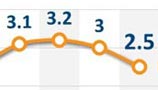
China's economy, under the "new normal" of slower growth and higher quality, expanded 7 percent in the first quarter, the lowest quarterly growth posted since 2009.
Speculation abounds as to whether China will implement QE. The Chinese version of the Financial Times on April 30 posted an article on whether China will join the QE club, citing evidence such as the larger-than-expected reserve requirement ratio (RRR) cut of one percent on April 20.
It is widely accepted that the People's Bank of China (PBOC) will inject more liquidity into the interbank market. In actuality, it has been injecting liquidity more aggressively since last year, an effort widely believed to maintain normal growth of the monetary base rather than to provide extra liquidity to the system.
But such liquidity injection is not QE.
QE, in essence, is a monetary policy regime change with an accelerated expansion of a central bank's balance sheet while policy rates are close to zero. Given China's monetary background, QE would mean a "more aggressive" expansion of the PBOC's balance sheet, but this is not what we are seeing.
The recent liquidity injections have mainly been to offset shrinking foreign exchange purchases in the maintenance of the normal expansion of the central bank's balance sheet. The bottom line is that there is no extra liquidity growth in terms of the monetary base or broad money (M2) from the PBOC's liquidity injections, according to Zhao Yang, an economist of Nomura.
The PBOC will continue to with its monetary policies such as RRR cuts, rate cuts and liquidity injections, but QE is not the correct term for its framework of monetary easing, as its balance sheet has never stopped expanding and will not suddenly jump due to asset buying like that of the the U.S. Federal Reserve (Fed), the European Central Bank (ECB) and the Bank of Japan (BOJ).
China's current situation is quite different from the United States, Japan and Europe and does not have market or legal systems mature enough to implement QE.
The country faces top tasks to restructure the economy and carry out further reform to achieve stable growth. Frenzied investment from the government, however, should be avoided, as it could lead to production overcapacity and high local debts.
China has vowed to maintain stable monetary policies this year. The market is overreacting to this "Chinese QE" story and misusing the term QE with regard to China's current monetary policies.

Copyright 1995 - . All rights reserved. The content (including but not limited to text, photo, multimedia information, etc) published in this site belongs to China Daily Information Co (CDIC). Without written authorization from CDIC, such content shall not be republished or used in any form. Note: Browsers with 1024*768 or higher resolution are suggested for this site.
License for publishing multimedia online 0108263 Registration Number: 130349