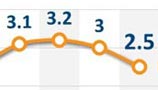
Nationwide property sales reversed March's 1.6 percent year-on-year decline to rise 7 percent year-on-year in April, posting its first positive print since 2013, buoyed by last year's low base and improved affordability plus market sentiment thanks to successive property policy easing measures in the past six months (three rate cuts, lowering of mortgage minimum down payment ratios, etc).
For now, strong sales momentum has continued into May according to high-frequency data.
Property construction and investment remained anemic, however. Possibly in preparation for the upcoming seasonal improvement in sales during May, new starts narrowed its previous almost 20 percent year-on-year contraction to 15 percent year-on-year in April.
However, land purchases fell heavily by 34 percent year-on-year again (the fourth straight month of a worse than negative 30 percent year-on-year reading) as property investment growth slipped further, from 6.5 percent year-on-year previously to only 0.5 percent year-on-year in April. Completions fell back into double-digit contraction as well. As a result, our property construction index slid again in April to -10.5 percent year-on-year (three month moving average).
Property sales have finally resumed positive growth, but we find it hard to say how long this can be sustained. Moreover, the sharp contrast with the continued decline in property construction and investment growth underscores why we think it could be extremely hard for policy to reverse the ongoing property slowdown.
Until the structural imbalance in China's property supply and underlying demand is resolved, a still-large inventory overhang may deter developers from resuming aggressive construction or investment plans – a trend that we expect to last through the rest of this year. Hence new starts will contract by another 10-15 percent in 2015, despite stabilizing sales.
As such, we still see property posing big downside pressures on the economy. If property sales decelerate again, or the property construction/investment deterioration worsens (as we expect it to later this year), more property policy easing will likely come through.
We had noted before that this latest cycle of government easing measures would likely take longer and more fire power than before to deliver any uplift to growth. The major fall in land sales (36 percent year-on-year in Q1) and property-related tax revenue, tightening controls on local government borrowing in the new local debt framework, and slower-than-expected "crowding in of corporate funds" via PPP (public private partnership scheme) are all likely to challenge the implementation of planned public investment works (e.g. railway and subways, water works, environment protection, energy and utilities).
Indeed, the worrying drop in April's medium- and long-term corporate loans should encourage the central government to speed up delivery of additional infrastructure investment financing via tools such as PSL (pledged supplementary lending) to policy banks and commercial banks.
Second quarter would be the earliest for any noticeable rebound to emerge in Chinese production and investment activities – April's data reminds us of the risk that this may not occur until Q3. Furthermore, we are only expecting a modest, transitory rebound.
By that, we mean a sequential improvement rather than a sharp year-on-year rebound in economic momentum (with Q2 GDP improving to 7.1 percent year-on-year from Q1's 7 percent year-on-year). The structural nature of the ongoing property downturn, still fragile state of global demand and transitory nature of policy support, all underpin why we expect GDP growth to slow again later this year, to average only 6.8 percent in 2015.
The article is co-authored by UBS economists Donna Kwok, Harrison Hu, Zhang Ning and Wang Tao. The views do not necessarily reflect those of China Daily.

Copyright 1995 - . All rights reserved. The content (including but not limited to text, photo, multimedia information, etc) published in this site belongs to China Daily Information Co (CDIC). Without written authorization from CDIC, such content shall not be republished or used in any form. Note: Browsers with 1024*768 or higher resolution are suggested for this site.
License for publishing multimedia online 0108263 Registration Number: 130349