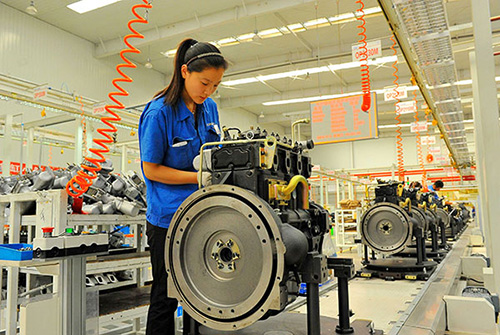
BEIJING - As China strives to sustain growth while the effectiveness of traditional demand-side policy support wanes, the country is turning to the other side, the supply side, for new vitality.
The country will take steps to expand aggregate demand while pushing forward "supply-side structural reform" in 2016 and beyond to support growth through new demand and productivity, top leaders at the annual Central Economic Work Conference agreed on Monday.
Why now
China used to rely on stimulating the demand side, including investment, consumption and exports, to support growth. However, the effectiveness of such a strategy has lessened.
The economy experienced acute volatility in the mainland equity market,disappointing economic indicators and a currency devaluation this year. The government appeared to have done everything it could, including five interest rate cuts and massive investment in infrastructure, but that was not enough to spur the slowing economy. ( "That's because it [the demand-side support policy] is no longer the remedy for the disease," said Li Zuojun, a researcher with the State Council Development Research Center (DRC), a government think tank.
Li said China's most pressing economic issues lie in the supply side, not the demand side. As an example, Chinese shoppers are looking to Japan to buy heated toilet seats, indicating a supply-demand imbalance rather than any lack of money or willingness to spend.
Balancing under-supply in some sectors, is over-supply in others, presenting major challenges said Wang Yiming, DRC deputy director.
China's growth slowed to 6.9 percent in the third quarters, the weakest pace since the global financial crisis, and is widely expected to post its lowest rate in a quarter of a century this year.
The central government started to stress "supply-side reform" several weeks ago, a turning point in macro-policy. It has been repeatedly mentioned by President Xi Jinping and Premier Li Keqiang.
This also comes as China steers toward a growth model based on domestic demand, innovation and the private sector instead of trade and credit expansion.
Supply-side reform will be a stepping stone for China to achieve its structural reforms during the 13th Five-year Plan period (2016-2020), said Wang Xiaoguang of the China Academy of Governance.
However, Zhao Yang of Nomura, thinks supply-side reform, which will increase long-term growth potential, is unlikely to offset strong headwinds in the short term.
What to do
China has vowed to "add new supply, create new consumption and form new growth momentum" through new ideas in institutions, technology and products.
The centerpiece of supply-side reform will be to remove regulatory barriers and give the market a bigger say in resources allocation, Wang Xiaoguang said.
According to a statement released Monday after the four-day meeting, supply-side reform will include more tax cuts, lowering corporate borrowing costs, incentives for specific industries, tackling factory overcapacity and property inventories and easing administrative restrictions.
To be more specific, the current proactive fiscal policy needs to be more forceful by cutting taxes and raising the fiscal deficit ratio gradually. Prudent monetary policy needs to be more flexible to create the monetary conditions for structural reform and lower costs, it said.
Nomura expects two 25-basis-point interest cuts in 2016 and projects that China's fiscal deficit will widen to 3 percent of GDP from an estimated 2.8 percent this year.
The government will offer more support for companies to upgrade technology and equipment and reduce debt, and will foster emerging sectors and encourage innovation in technology, products and business models.
In eliminating overcapacity, China will create conditions for bankruptcy procedures based on market rules, and speed up liquidation cases.
The country also vowed to make it easier for migrant workers to settle in cities and encourage them to buy or rent property where they work.

Copyright 1995 - . All rights reserved. The content (including but not limited to text, photo, multimedia information, etc) published in this site belongs to China Daily Information Co (CDIC). Without written authorization from CDIC, such content shall not be republished or used in any form. Note: Browsers with 1024*768 or higher resolution are suggested for this site.
License for publishing multimedia online 0108263 Registration Number: 130349