NEW YORK -- China has enough resources to realize 6.5-percent growth and has made encouraging headway on structural adjustments, said Stephen Roach, an economist with Yale University.
Roach, a senior fellow of Yale University's Jackson Institute of Global Affairs who was just back from Beijing, told Xinhua on Thursday that his impression is that there is less concern inside China than outside China.
"The broad conclusion inside China is (that) there remains confidence in the leadership and confidence in the strategy to address these issues," said Roach.
In his view, China's economy is doing well, much better than what the market is concluding.
"The slowed growth rate is a reflection of the structure shift in the Chinese economy, away from manufacturing and construction to services. For any economy, it means a slower growth; China is not an exception."
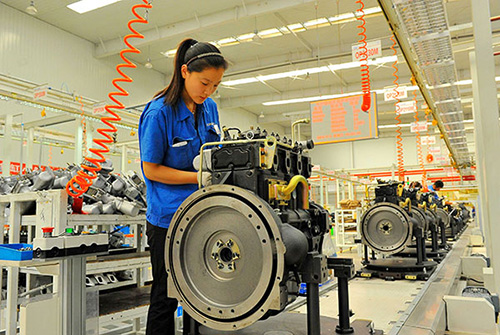
China's industry sector is obviously being hit by weak global demand and the lagged impacts of RMB appreciation. Those are the ongoing source of weakness, said Roach, who was chief economist of Morgan Stanley and former chairman of Morgan Stanley Asia.
However, the emerging growth of China's service sector can offset the blows, he said.
"The growing service sector can't completely compensate the declining industry sector. The important thing is service sector can compensate a large portion of reduced employment from industry sector. It's more important than GDP."
He said he believes that as long as the Chinese government commits itself to the restructuring and move aggressively to execute the reform, China can definitely achieve the growth rate of 6.5 percent.
China's slowdown, he noted, will affect major commodity exporters like Australia, Canada, Russia, Brazil as China is moving away from an industry-driven model to a carbon-light services model, resulting in less demand for commodities.
But the good news is that China, if successful in rebalancing its economy, will create a huge demand for consumer goods, he pointed out.
"That's enormous opportunities for countries to sell things to Chinese consumers. That's a plus in the current difficult global economic environment," he said.
Meanwhile, he added that capital outflow from China will not trigger a crisis like what happened in Asia in the late 1990s. "There is a lot of difference between China and East Asia economies during the crisis back then," he said.
China is still running a considerable current account surplus whereas all of those economies were in deficit at the time of the crisis, said Roach, adding that China today has over 3 trillion dollars in currency reserves and those countries had run out of reserves.
In addition, he noted, those economies were all vulnerable to short-term capital outflows, and they had short-term foreign liabilities quickly rushed out the country, while China has limited exposure to that kind of capital.
"China learned really important lessons during the later 1990s," he said, pointing out that the large foreign currency reserve China has built up after the Asian crisis is a huge cushion to deal with the problems just like that.
The main challenges to the Chinese economy, he added, have much to do with the implementation of the reforms which have already been proposed.
In his view, to balance the economy, the government needs to accomplish three main objectives: more employment growth, continuous urbanization, and building a strong and secure social safety net.
He commented that the Chinese government has done a good job in the first two, but still lags in the third.
"The government has proposed a number of reforms in the last two years to deal with social security and health care, household registration reform, one-child policy, that are all encouraging as the safety net is getting attention."
"If they don't quickly implement the safety net reforms, the economy will get stuck in a sort of incomplete structure-change rebalancing. That will be proved to be a great risk for Chinese economy," he said.
As regards the upcoming annual session of China's legislature in March, Roach said he is looking for a clearly outlined framework of a new five-year plan.
"Last year the Chinese government gave us some hints on what to expect in terms of the growth and some broad reform proposals," he said.
He said he looks forward to a clarification of what the government is actually doing, as well as the timelines of social safety network reforms and household registration reforms.
"The market wants to hear a clear and much more precise timeframe by which the government is moving to address economic challenges," he added.

Copyright 1995 - . All rights reserved. The content (including but not limited to text, photo, multimedia information, etc) published in this site belongs to China Daily Information Co (CDIC). Without written authorization from CDIC, such content shall not be republished or used in any form. Note: Browsers with 1024*768 or higher resolution are suggested for this site.
License for publishing multimedia online 0108263 Registration Number: 130349