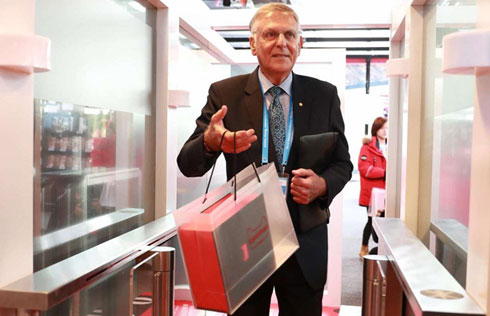
Foreign elevator brands account for 80 percent of the Chinese market, the world's largest. ThyssenKrupp Elevator, from Germany, is setting up a new factory in Zhongshan in the southern province of Guangdong with an investment of 300 million yuan. It is expected to be completed next year.
Andreas Schierenbeck, CEO of ThyssenKrupp Elevator AG, says part of its strategy in China is to invest in expensive technology to improve research and development and operational efficiency due to ever-increasing labor and operational costs.
Due to a shortage of qualified technicians, newcomers to the market in China often try to lure experienced and trained people from established companies through offering higher wages, but ThyssenKrupp says it will invest heavily in training. The company's global training center in Shanghai, SEED Campus, trains administrative and management staff as well as field technicians.
The company also plans to expand its business locations in the country from 184 to 250, covering most regions, to meet the growing demand for elevators and escalators in the newly emerging mega cities.
China's urban population is expected to swell to a billion by 2025, and the country will have as many as 221 cities, 10 of them with a 10 million-plus population, the consultancy firm McKinsey & Co states in its latest report.
As cities get bigger, so do the buildings, and there will be more growth potential for elevator companies.
Alan Cheung, president of Xizi Otis Elevator Co Ltd, the largest subsidiary of the US-based Otis company, says there is 51 percent urbanization in China at present, with still a long way to go to achieve the 80 percent urbanization level of Western Europe and the US.
"If China's urban population maintains an increase of 1 percentage point each year, about 15 million rural residents will enter cities," he says. "That population will increase demand for urban infrastructure and thus the demand for elevators and escalators during the process of social transformation."
Otis, one of the largest elevator manufacturers in terms of units every year, has built a factory in Chongqing to expand into central and western China.
"We chose Chongqing as our second production base in line with the government's long-term policy to develop the interior and western areas rather than just the coastal cities," he says.
Cheung says another growth point in China's elevator market arises from demand for repair and maintenance services. There are about 2 million units installed in China requiring maintenance.
"We want to be a service-oriented company instead of just a manufacturer or an equipment installation company," says Cheung, adding that the company's strategy for the future was built around customers' requirements.
The US company will continue to invest in the after-sales sector, expanding its repair and maintenance service staff by 30 percent to about 1,500 over the next few years.
"We expect profits to be maintained in the coming years, but we have to be more competent," he says.
The Finnish company Kone hopes to strengthen its position in the Chinese market by increasing its share in Giant Kone Elevators from 40 percent to 80 percent in 2011.
In April, Kone elevator industrial park was established in Kunshan, near Shanghai. At 240,000 square meters, the new Kone Park includes three elevator factories and one escalator factory.
Matti Alahuhta, CEO of Kone, was quoted by the Financial Times as saying that Giant Kone was especially strong in third and fourth-tier cities.
"As growth slows in the coastal cities, urbanization is moving to the central and western parts of the country, so those markets are still growing very fast," he says.
Alahuhta cites forecasts that the world's 600 biggest cities will account for 62 percent of global economic growth between 2007 and 2025. An increasing proportion of those cities are in China.


Copyright 1995 - . All rights reserved. The content (including but not limited to text, photo, multimedia information, etc) published in this site belongs to China Daily Information Co (CDIC). Without written authorization from CDIC, such content shall not be republished or used in any form. Note: Browsers with 1024*768 or higher resolution are suggested for this site.
License for publishing multimedia online 0108263 Registration Number: 130349