|
|

Home
> News
|
European countries call on G20 to tackle bonuses(Agencies)
Updated: 2009-09-04 20:59 LONDON: European countries made a concerted push on Friday to put the thorny issue of bankers' pay and bonuses at the top of the agenda for a meeting of finance officials from the Group of 20 nations. With finance ministers and central bankers from the G20 expected to use the London meeting to stress their commitment to boosting the global economy, several European countries also want an agreement to curb bankers' bonuses, which many have blamed for the crisis as they can encourage excessive risk-taking. The initiative has received a lukewarm response from the United States, which instead wants to start talks on a new international accord to increase banks' capital reserves.
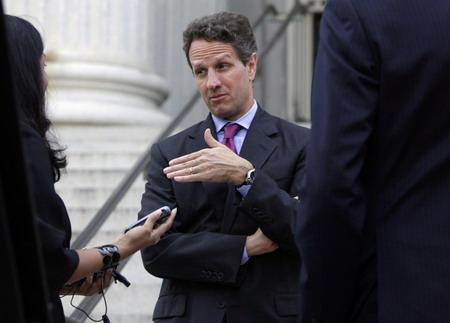
US Treasury Secretary Timothy Geithner has downplayed the talks to be held Friday and Saturday as a "stock-taking meeting, not a new-initiatives meeting" on the road to the leaders' summit in Pittsburgh later this month. In a joint opinion piece in Swedish daily Dagens Nyheter published on Friday, the finance ministers of Sweden, France, Spain, Germany, Italy, Luxembourg and the Netherlands said bonuses guaranteed for more than a year should be banned.
The seven European countries called excessive payouts not only "dangerous" but also "indecent, cynical and unacceptable." G20 leaders promised at their London meeting in April to pass "tough new principles on pay and compensation." Britain has supported the European push to tackle bank bonuses, but has stopped short of some of the more stringent proposed new rules. British Treasury chief Alistair Darling said that bonuses and boosting capital were international issues that needed to be addressed as the banking sector was key to any recovery "Nowadays, no one large bank can simply operate in a vacuum, they operate right across the world, so this truly is an international problem," Darling told BBC radio on Friday. The finance ministers and central bank officials from rich and developing countries representing 80 percent of world economic output are convening amid mounting signs of an economic recovery. Japan, Germany, France and Australia all recorded growth in the second quarter while Britain is widely expected to do so in the third quarter. They are expected to agree on an ongoing commitment to boosting the economy, but there is friction over when exactly to scale back stimulus efforts. Despite the nascent signs of recovery, fears remain that curtailing government spending and monetary stimulus via low interest rates and money supply boosts too soon could result in a "double dip" recession. International Monetary Fund Managing Director Dominique Strauss-Kahn said that stimulus measures adopted to combat the global crisis should be withdrawn only when the economic recovery has taken hold and unemployment is set to decline. "I am concerned about the social and economic costs of high unemployment, which will persist even as financial markets and output stabilizes," Strauss-Kahn said in Berlin on Friday. British Prime Minister Gordon Brown, French President Nicolas Sarkozy and German Chancellor Angela Merkel issued a joint letter on Thursday urging the G20 to stick to stimulus plans, while avoiding future imbalances in the global economy such as excessive budget deficits. The timing of a so-called exit strategy is a point of contention, with Britain and the United States saying it is too early to consider. By contrast, German Finance Minister Peer Steinbruck recently called for the reduction of government spending measures as soon as possible. Geithner wants to start talks on a new international capital accord that he says would put in place "a more conservative framework of constraints on leverage in the financial sector across the major globally active financial institutions." The accord would be developed under the auspices of the Financial Stability Board, an international body that was recently expanded to include major emerging economies such as China, India and Brazil. The Obama administration's proposal would establish stronger international standards for the reserves banks are required to hold to cover potential loans. The US wants to reach agreement on an accord by the end of 2010, with countries agreeing to implement the plan by the end of 2012. The big emerging economies like China, India and Brazil have their own agenda at the London meeting, most clearly faster action on changes to give them a greater say in governance of financial markets. The G20 countries have agreed to review the leadership of institutions like the World Bank and IMF, which has received pledges of more money to help struggling countries. The IMF is customarily headed by a European and the World Bank by an American. The G20 includes 19 countries: Argentina, Australia, Brazil, Canada, China, France, Germany, India, Indonesia, Italy, Japan, Mexico, Russia, Saudi Arabia, South Africa, South Korea, Turkey, Britain and the United States. The European Union, represented by its rotating presidency and the European Central Bank, is the 20th member. |
主站蜘蛛池模板: 色综合色狠狠天天综合网| 亚洲欧美日韩精品久久亚洲区色播| 国产尤物av尤物在线观看| 麻豆成人传媒一区二区| 无码国产精品一区二区av| 亚洲熟妇色xxxxx欧美老妇| 粉嫩在线一区二区三区视频| 亚洲精品一区二区口爆| 亚洲AV成人无码久久精品| 97国产成人无码精品久久久| 亚洲人成成无码网WWW| 亚洲成a人片77777在线播放| 国产亚洲精品久久久久久无亚洲| 国产高清精品在线一区二区| 国产精品午夜福利视频| 强奷乱码中文字幕| 伊人久久大香线蕉综合影院| 噜噜综合亚洲av中文无码| 亚洲AV无码无在线观看红杏| 久久久久久久久毛片精品| 视频一区视频二区在线视频| 亚洲人妻一区二区精品| 国产成人免费一区二区三区| 亚洲人视频在线观看| 99久久亚洲精品影院| 国产亚洲精品成人av久| 国产精品多p对白交换绿帽| 免费大黄网站在线观看| 午夜男女爽爽影院免费视频| 久久精品人人做人人爽97| 女人香蕉久久毛毛片精品| 激情综合网一区二区三区| 国产精品福利自产拍在线观看| 中文字幕午夜五月一二| 亚洲国产日韩一区三区| 九色免费视频| 大香伊蕉在人线国产免费| 亚洲av激情一区二区三区| 亚洲国产五月综合网| 成 人免费va视频| 99在线小视频|