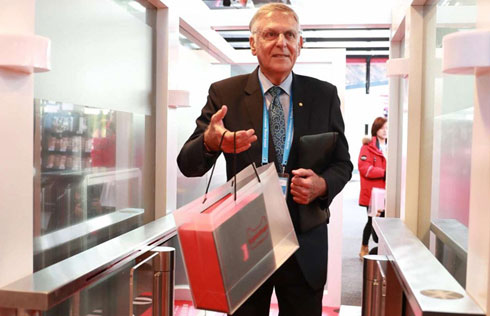
"When a manufacturing enterprise grows, it naturally expands to its downstream and upstream products, but everyone in this alliance will do and only do what they are good at," Wang said. "We want to get more focused to offer products of higher quality. When we get fine enough grass, others can then produce fine beef, milk and honey, which will eventually alleviate people's concerns over food safety. We don't want too much business crossover within individual companies, but the results can be a win-win situation if we share resources and save costs."
According to Tian Qingsong, director of the administrative office at the Institute of Grassland Research under the Chinese Academy of Agricultural Sciences, which joined the alliance, a fine grass variety developed by academic institutions usually takes more than one decade to finally enter the market.
"The process is slow because we do not have enough capacity to take the risk marketing all the varieties and can only rely on government promotion. It's not economical in that way," Tian said.
"More involvement by enterprises will make things better. We offer our technical guidance and nurture mature technician squads within the enterprises, who are closer to the market and more able to develop varieties meeting different niche markets."
There have certainly been some successful trials on the Inner Mongolian grasslands.
The Ar Horqin Banner in the eastern city of Chifeng was named the nation's "grass capital" by the China Animal Agriculture Association in July. The banner has grown 40,000 hectares of high-yield grass since the local government began to promote growing the crop in 2008 as a solution to ameliorate desertified grassland and break down the problem caused by ensuring the grass-livestock balance policy was maintained. Most of the grass is alfalfa imported from the United States and Canada, according to Xu Feng, director of the Ar Horqin Grass Industry Association. The area is to be increased to 66,700 hectares by the end of 2015.
"However, alfalfa is only allowed to be planted in severely desertified areas, because we still need to keep the local original varieties because of ecological safety concerns," Xu said.
A hectare of local land can produce up to 15,000 kilograms of alfalfa, compared with merely 750 kg of local varieties.
Although Wang from Monsod said foreign seeds occupied the vast majority of alfalfa planted in Inner Mongolia, he also revealed local enterprises, including his, are exploring domestic breeds seeking equally high yields.
In 2012, Inner Mongolia established 500 model family ranches all over the region with certain criteria for their infrastructure and the application of eco-friendly economic patterns.
"A healthy business model combining the restoration of the natural environment while making money will still rely more on individual herdsmen, but their cooperative can be run in a more scientific way," said Yu Guangjun, head of the Economic Research Institute affiliated to the Inner Mongolia Academy of Social Sciences. He is cautiously optimistic about the potential.
"We can make more accurate calculations of the scale of the family ranch-based local price levels, incomes and ecological conditions, rather than simply make the same ranches everywhere. Inner Mongolia has various kinds of grasslands. No specific business model is suitable for such a vast land although it may work out across some areas."
"It will be easier to begin from the urban outskirts where enterprises are able to use more abandoned land. We have already seen some successful approaches."
Monsod finished an ecological restoration project in June, turning 692 hectares of wasteland in the northern outskirts of Hohhot into grassland as a new tourist site as well as a platform for more environmental experiments.
"But we are still waiting for a good example of a big company experiencing continuous profits from the vast grasslands, where more difficulties and uncertainties exist," Yu added.


Copyright 1995 - . All rights reserved. The content (including but not limited to text, photo, multimedia information, etc) published in this site belongs to China Daily Information Co (CDIC). Without written authorization from CDIC, such content shall not be republished or used in any form. Note: Browsers with 1024*768 or higher resolution are suggested for this site.
License for publishing multimedia online 0108263 Registration Number: 130349