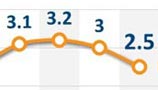
"We have taken a view that the size of devastation, while large in absolute terms, has not been sufficient to impact a rating overall," said S&P in the report. "However, assuming that extreme weather events are on the rise in terms of frequency and destruction, how this trend could feed through to our ratings on sovereign states bears consideration."
|
 |
|
 |
S&P considers three variables to determine the risk to individual economies posed by climate change: The population living in low-lying coastal areas, the share of agriculture in national GDP, and a vulnerability index.
And Asia is right in the crosshairs of this trend. The 20 most vulnerable nations to climate change are emerging markets and half of them are in Asia Pacific.
Countries like Vietnam, Bangladesh, Fiji, the Philippines, Papua New Guinea and Indonesia that rely heavily on agriculture and employment for growth have "weaker capacity to absorb the financial cost" of shifting or extreme weather events.
In East Asia, the climate has been getting warmer for five decades with mean temperatures expected to rise by almost 2 C or more by 2050 and almost 4 C by 2090. Countries in the region are adapting, says the ADB, and the question is how they are adapting and how much it costs to adapt.
East Asia can afford to adapt to the new climate reality but the bill is likely to be high, at about $23 billion per year for new infrastructure between 2010 and 2050, another $4.2 billion for coastal protection and $9.5 billion for changes in agricultural patterns such as more and newer irrigation systems or consumer subsidies to ensure food remains affordable.
All told, adaptation could cut 5.3 percent from annual GDP growth by 2100, says the ADB.
"Public authorities and civil organizations can contribute to such adaptation by collecting and disseminating information on the impacts of, and potential responses to, climate change," says the ADB. "The essence of planned adaptation is thinking ahead."
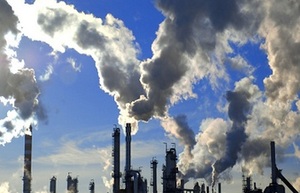
Policymakers need to push for a model of economic growth that limits carbon emissions and a more efficient use of resources. Carbon trading schemes are one approach in which countries like China, Japan and South Korea have made some progress.
|
 |
 |
| China launches carbon trading in Hubei | Tianjin starts carbon trading market |


Copyright 1995 - . All rights reserved. The content (including but not limited to text, photo, multimedia information, etc) published in this site belongs to China Daily Information Co (CDIC). Without written authorization from CDIC, such content shall not be republished or used in any form. Note: Browsers with 1024*768 or higher resolution are suggested for this site.
License for publishing multimedia online 0108263 Registration Number: 130349