|
|
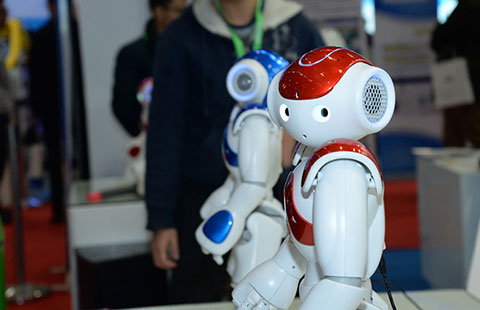
BYD Auto's representative and the new energy vehicle maker's four models are pictured at the Wuhan Motor Show in Wuhan, Hubei province, on Oct 12. [Photo by Hao Yan/China Daily] |
Growth in the new energy vehicle market was hit in September due to the government's postponement of the release of an electric bus subsidy plan, after extensive fraud cases dealt a heavy blow to the sector.
A total of 289,000 new energy vehicles were sold in the first nine months of 2016, more than double that during the same period last year, according to China Association of Automobile Manufacturers on Oct 12.
But, about 44,000 new energy vehicles were shifted in September, with growth slowing to 44 percent year-on-year, almost half the 85 percent monthly growth seen in August.
The significant slowdown in the sector came after the government slammed on the brakes, postponing the detailed subsidy scheme for new energy coach and bus products.
CAAM Deputy Secretary-General Shi Jianhua said: "The government policy gives strong clout to the development of the new energy vehicle sector. Without the subsidy plan, the nation would struggle to meet the 500,000-unit sales volume target this year."
He expects that the updated subsidy scheme will be released soon, and that carmakers will quickly feel the effects.
The Ministry of Finance's second round of penalties started from Oct 12, with two listed companies, including Chongqing Lifan Passenger Vehicle, whose 2,395 electric vehicles manufactured from 2015 onwards failed to meet requirements.
Lifan's EV production plunged in August, with only 13 electric buses rolling off the production line, 95 percent less than its volume in August 2015.
On Sept 8, the MOF announced penalties for five new energy coach makers involved in abusing a total of over 1 billion yuan ($149.2 million) of subsidies.
Four ministries joined forces in January to probe 92 domestic EV makers for illegally obtaining government subsidies. Local media outlets revealed that major domestic brands were on the list, including FAW Group, SAIC, Dongfeng Motor, BAIC Group, BYD Auto, Zhejiang Geely, and Chery Automobile.
The scam took advantage of the government's intensified efforts to encourage the use of new energy vehicles, which aimed to upgrade the industry and ease pressure on the environment. The policies included tax exemptions, subsidies for car purchases and the requirement of government bodies to buy more new energy cars.
CAAM's statistics also showed that nearly 2.6 million passenger vehicles were sold in the world's largest auto market in September, a jump of 26.1 percent compared to last year.
The first nine months of 2016 saw a recorded vehicle sales volume of 19.4 million units, expanding 13.2 percent on the same period in 2015.
According to industry analysts, the momentum is due to a range of factors, including demand fueled by enthusiasm for sport utility vehicles, a lowered confidence in stock market investments and the determination of dealers to meet end-of-year sales targets.
Policy powered EVs
Director of the Manufacturing Industry Office of the State Information Center, Li Weili, indicated that the domestic new energy vehicle sector was driven by government policies instead of the market, with the country giving the "most generous subsidies in the world".
Selling a single fully electric bus used to be eligible for hundreds of thousands of yuan in subsidies, from both central and local governments. Meanwhile, a fully electric car would be eligible for more than 100,000 yuan in total in some places, where district-level subsidies were available besides the municipal and central governments.
The central government subsidy scheme defined a decreasing amount of incentives for the five years of 2016-20, in the hope of encouraging EV makers to lower their prices while discouraging reliance on subsidies. The amount of subsidies from the municipal level would match the amount from the central government.
However, to maintain the market size after the government subsidy has faded away, the EV price needs to be lowered to a similar level to combustion engine vehicles, and to do so, the cost of an AA battery cell has to be lowered to around 1 yuan each, according to Li's calculation.
Take Tesla's battery pack as an example. It is made up of more than 7,000 of the commodity battery cells with "best pricing" that ranges from 80 cents to $2 and up per cell, according to earlier media reports.
Li said: "The future lies in traction battery technology breakthroughs, but an alternative has not yet been identified. The most important aspect in traction batteries is product consistency, so robot automation is the key to domestic EV production."
"The development road is going to be a bumpy one in the next 10-20 years, after five years of smooth development."
Fu Yuwu, chairman of the Society of Automotive Engineers of China said: "Government bodies have been proactive in supporting innovations in the field, but its industrial scale is the foundation of the technology's development."
The domestic market overtook the United States in 2015, becoming the world's largest for new energy vehicles. The number of new energy vehicles sold last year more than tripled year-on-year to 331,100 units, from 74,763 in 2014, according to CAAM data.
However, the current market situation does not reflect future competition. The major international carmakers are waiting and watching. In August, Volkswagen announced its local production plan for new energy models.
Li said: "The big auto makers have existing product design and technology in hand, but they won't start until they have to. Some of them have not entered the EV field, but they will as soon as the credit system launches."
"The subsidy is the carrot, and the future dual credit system is the stick."
Contact the writer at haoyan@chinadaily.com.cn

Copyright 1995 - . All rights reserved. The content (including but not limited to text, photo, multimedia information, etc) published in this site belongs to China Daily Information Co (CDIC). Without written authorization from CDIC, such content shall not be republished or used in any form. Note: Browsers with 1024*768 or higher resolution are suggested for this site.
License for publishing multimedia online 0108263 Registration Number: 20100000002731