Fashion's blind spot
Updated: 2013-09-22 07:55 Comments
  Print
Print  Mail
Mail  Large Medium Small
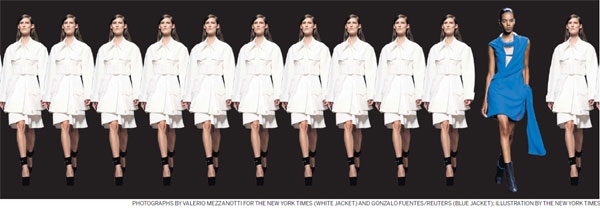
A stark absence of black models for many designers
Five years ago, the fashion industry faced a reckoning over the startling lack of diversity among the models on major designer runways. Reacting to complaints, Vogue, in its July 2008 issue, featured a substantial article that asked, in its headline, "Is Fashion Racist?"
This came shortly after Franca Sozzani, the editor of Italian Vogue, published a provocative issue using only black models; Bethann Hardison, a former model and agent, initiated a series of panel discussions on the subject; and Diane von Furstenberg, the president of the Council of Fashion Designers of America, urged members to be more aware of diversity in casting.
And since then, almost nothing has changed.
The New York shows are as dominated by white models as they have been since the late 1990s, roughly at the end of the era of supermodels. After a notable increase in 2009 that followed extensive news media coverage, the representation of black models has remained fairly steady until this year. Jezebel, a blog that tracks the appearance of minorities in fashion shows, said they accounted for only 6 percent of the looks shown at New York Fashion Week in February (down from 8.1 percent the previous season); 82.7 percent were worn by white models.
In Europe, where Phoebe Philo of Celine, Raf Simons of Dior and others have presented entire collections using no black models, the opportunities have been even less favorable for minorities.
"There is something terribly wrong," said Iman, one of the most recognizable models in the world, who later created a cosmetics company. Her experience in the 1980s and'90s, when designers like Calvin Klein, Gianni Versace and Yves Saint Laurent routinely cast black models, was starkly different than that of young nonwhite models today, when the racial prejudice is all but explicitly stated.
"We have a president and a first lady who are black," Iman said. "You would think things have changed, and then you realize that they have not. In fact, things have gone backward."
Ms. Hardison said that, for her, the most astonishing aspect of the persistent lack of diversity is that there have been no real repercussions.
"No one in power slaps these designers around," she said.
Beginning at New York's Fashion Week earlier this month, Ms. Hardison was organizing a social media campaign to bring public scrutiny to designers who did not use black models.
James Scully, a casting director whose clients include Tom Ford, Derek Lam and Stella McCartney, went public in March with a scathing critique of shows that did not reflect a diverse casting, naming Dior, Saint Laurent, Louis Vuitton and Chanel.
"I feel the Dior cast is just so pointedly white that it feels deliberate," he said in a BuzzFeed article.
In July, when Mr. Simons presented his couture collection for Dior, the show included six black models, prompting speculation that the change came in response to Mr. Scully's remarks. That week, Prada released a campaign featuring Malaika Firth, the first black model to appear in its women's advertising in nearly two decades.
Representatives for both labels refused to discuss the subject.
Calvin Klein, once a vastly diverse show, has been faulted for its mostly white casting.
At the New York show this month, there were signs that the recent pressure could bring changes. There were five black models in the 35-look Calvin Klein show on the final day. But over all the changes were small: more than half the designers who were faulted last season used two or more black models this season, but it was only two for the majority of them. And many people noticed that there were no Asian models at the show.
Francisco Costa, the women's creative director, said in an e-mail that the company looks for diverse faces in its casting. But, he wrote: "There are only a handful of top-level, professionally trained models of color at a particular level out there now, and they end up being booked by other fashion houses and can be seen on dozens of runways each season, which is counter to what we are looking for."
Riccardo Tisci, the Givenchy designer, who has been heralded for representing a range of races, ages and genders, says those who cast only white models do so out of "laziness."
"There are not only white people around the world," he said.
Veronica Webb, who encountered excuses when she walked the runways in the'90s, said the issue is an important one for young women.
"When you see someone that looks like you," Ms. Webb said, "it makes women feel beautiful, and it makes women feel they belong."
The New York Times