Valuations of many homegrown companies are far higher than those in the US during the dotcom peak of 2000, reports Bloomberg.
The world-beating surge in Chinese technology stocks is making the heady days of the dotcom bubble look tame by comparison.
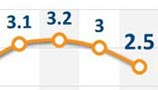
The industry is leading gains in China's $6.9 trillion stock market, sending valuations to an average 220 times reported profits, the most expensive level among global peers. When the Nasdaq Composite Index peaked in March 2000, technology companies in the United States had a mean price-to-earnings ratio of 156.
Like the rise of the Internet two decades ago, China's technology shares are being fueled by a compelling story: the government is promoting the industry to wean Asia's biggest economy from its reliance on heavy manufacturing and property development. In an echo of the late 1990s, Chinese stocks are also gaining support from lower interest rates, a boom in initial public offerings and an influx of money from novice investors.
The good news is the technology sector makes up a smaller portion of China's equity market than it did in the US 15 years ago, limiting the potential fallout from a selloff. The bad news is that any reversal in the industry will saddle individual investors with losses and risk putting an end to the Shanghai Composite Index's rally to a seven-year high.
"Chinese technology stocks do resemble the dotcom bubble," said Vincent Chan, the Hong Kong-based head of China research at Credit Suisse Group AG, Switzerland's second-biggest bank. "Given stocks fell 50 to 70 percent when that bubble burst in 2000, these small-cap Chinese shares may face big corrections when this one deflates."
China's government is boosting spending on science and technology as a faltering industrial sector drags down economic growth to the weakest pace in 25 years. In March, Premier Li Keqiang outlined an "Internet Plus" plan to link Web companies with manufacturers. Authorities also plan to give foreign investors access to Shenzhen's stock market, the hub for technology firms, through an exchange link with Hong Kong.
Among global technology companies with a market value of at least $1 billion, all 50 of the top performers this year are from China. The sector has the highest valuations among 10 industry groups on mainland exchanges after the CSI 300 Technology Index climbed 69 percent in 2015 through Tuesday, more than three times faster than the broader measure.
Technology companies have posted the biggest gains among Chinese initial public offerings during the past year, helped by a regulatory ceiling on valuations for new share sales. Beijing Tianli Mobile Service Integration Co is the top performer among 147 offerings during the period after surging 1,871 percent from its offer price to trade at 379 times earnings.
Valuations in China are now higher than those in the US at the height of the dotcom bubble just about any way you slice them. The average Chinese technology stock has a price-to-earnings ratio 41 percent above that of US peers in 2000, while the median valuation is twice as expensive and the market capitalization-weighted average is 12 percent higher, according to Bloomberg.
Teng Bingsheng, an associate dean at the Cheung Kong Graduate School of Business in Beijing, said on Tuesday: "It's a bubble in the making. Valuations are extremely expensive."
China lacks some of the most extreme excesses of the dotcom era because of regulations that require any company seeking a listing on the nation's biggest exchanges to be profitable.
Gui Haoming, the Shanghai-based director of the wealth management research department at Shenwan Hongyuan Group Co, the nation's second-biggest brokerage by market value said: "High valuations don't necessarily mean that they are unreasonable. Some of the valuations can be digested by high earnings growth."
The smaller size of China's technology sector also makes it less likely that a reversal in the rally will cause a broader tumble in equities. The industry accounts for 13 percent of the country's overall market capitalization, compared with about 31 percent for the US in 2000, data compiled by Bloomberg show. It took the Standard & Poor's 500 Index about seven years to recover from the aftermath of the dotcom bubble. The Nasdaq Composite has yet to reclaim its high.
While Haitong Securities Co's Chen Ruiming said it is hard to predict when China's rally will end, he sees growing signs of speculative behavior.
The use of margin debt to trade mainland shares has climbed to all-time highs, while investors are opening stock accounts at a record pace. More than two-thirds of new investors have never attended or graduated from high school, according to a survey by China's Southwestern University of Finance and Economics.
Money has flowed into Chinese stocks in part because the central bank is cutting interest rates to support growth, something the US Federal Reserve did in 1998 to revive confidence amid Russia's sovereign debt default and the collapse of the hedge fund Long-Term Capital Management.
Like the dotcom bubble, China's high-tech boom is creating a new class of wealth-at least on paper. No less than 12 technology billionaires have been created this year, according to the Bloomberg Billionaires Index. They include Beijing Tianli Mobile's Chairman Qian Yongyao and He Ye, a co-founder of Shenzhen InfoTech Technologies Co. That stock has surged 274 percent since the start of January and is valued at 2,628 times earnings.
"Many of these technology companies have bubble-type valuations as speculators take advantage of popular concepts to ramp up shares," said Haitong's Chen, a strategist in Shanghai. "Only a very small group, say 5 percent or 10 percent, will make it to become larger companies."

Copyright 1995 - . All rights reserved. The content (including but not limited to text, photo, multimedia information, etc) published in this site belongs to China Daily Information Co (CDIC). Without written authorization from CDIC, such content shall not be republished or used in any form. Note: Browsers with 1024*768 or higher resolution are suggested for this site.
License for publishing multimedia online 0108263 Registration Number: 130349