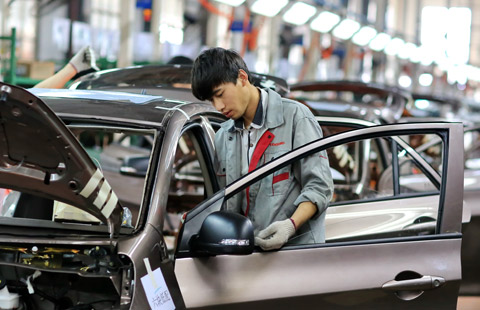
Shenzhen, China's global dream-driven hub for innovation
BEIJING — Michel Haese's first visit to Shenzhen was purely a coincidence.
What was more unexpected for the 55-year old German was that this Chinese city would help make his childhood dream come true.
Dreamland for start-ups
When he was a kid, Haese loved to build things with whatever he could find - cans, lids, ribbons, motors, lamps, batteries. Growing up, he tried being a radioman, a photographer, but he never abandoned his dream of becoming an inventor.
Haese first heard about Shenzhen as a special economic zone in China more than 20 years ago at the world's largest computer expo in Hannover, Germany.
In 2011, Haese planned to visit a traditional electronic fair in Hong Kong, but a friend of his dragged him to another one. There he met some Chinese entrepreneurs who later invited him to travel to the southeastern Chinese metropolis to see their factories.
"Shenzhen is a paradise for development," he said. "If you have any requirements or needs for new electronics, I go downstairs and I can find them." He was referring to Huaqiangbei, one of the world's largest and most bustling electronics markets packed with small shops selling all kinds of electronic gadgets.
Haese is now the chief executive officer of his own start-up in Shenzhen. His primary invention, the "Lapscreen," is more of a notion than a product. With a Lapscreen, one can project all the functions of a smartphone onto an A4-paper-sized portable full-HD monitor, like typing a story or watching a movie. With it, Haese hopes to share his "portable office" idea with willing partners from the whole world.
Haese is certainly not the only dream chaser who regards this mega city as his ultimate destination.
Cyril Ebersweiler is the co-founder of HAX Accelerator, a seed accelerator focused on hardware start-ups based in Shenzhen and San Francisco. Together with 10 hardware firms, the 38-year-old Frenchman founded HAX in a garage in Shenzhen in 2011.
"One thing we discovered while leveraging the supply chain for these start-ups was that Shenzhen was a good place to prototype - and not just consumer electronics hardware, but also extremely complex hardware for the health, robotics, and fabrication spaces," he told Xinhua.
For six years, HAX has sought to speed up business ideas from 3D printers to drones, as well as other consumer product devices for more than 145 start-up companies. It offers guidance and expertise from start to finish.
Every year, Ebersweiler brings teams whose members come from all over the world, more than half of them from the United States or Europe, to Shenzhen. "What we had to develop at the time was an effective way for them to be operating in China," he said.
In Ebersweiler's opinion, it is Shenzhen's unique advantage to have a lot of small factories supporting the big ones. He calls it "the long tail of manufacturing in China." He has also been spearheading a "lean hardware" movement to refashion the way products are made by integrating the prototyping phase and manufacturing phase as much as possible.
He believes the city's prevalent culture of open sources is precisely what start-ups need to do small manufacturing runs effectively with a lot of flexibility and comparatively low cost so as to reduce time to the market.
"It's very difficult, or it's actually impossible to do that in Silicon Valley. You have to go online, order something, waiting for four or five days, get it shipped, play with it, doesn't work, do it again," he said.
Nursery for global brands
Shenzhen has not only helped new businesses to break out of the shell, but also nurtured many of China's world-class technological enterprises, especially in the global smartphone industry.
Huawei, China's Shenzhen-based telecommunications giant, was founded in 1987. It has now become a leading global smartphone manufacturer.
According to analysis by consulting firm Counterpoint Research, it has overtaken Apple in terms of global smartphone sales in June and July, the first time in history.
Thanks to designs with large displays and advanced camera functions, Chinese cellphone makers have now become increasingly popular among overseas customers.
Matilda von Sydow leads a local philanthropic group in Oslo, Norway. She now uses Huawei's P10 Lite phone.
"I'm very pleased with my purchase ... As an android user I see no reason to choose another brand, the phone has all the qualities I'm after plus more," she said, noting that many of her friends and family members also use Huawei phones.
Elliot Mulley-Goodbarne, a news editor with Mobile News, a leading mobile industry trade newspaper in Britain, told Xinhua that he believes Huawei's success is a testament to high quality and more reasonable prices.
Compared to Huawei's venture in the developed world, Transsion Holdings, also headquartered in Shenzhen, has its eyes locked on the continent of Africa.
The market share of mobile brands under Transsion reached 38 percent in Africa last year, according to the International Data Corporation (IDC), a key provider of market intelligence and advisory services for information technology and telecommunications. It means that for every three mobile phones sold in the continent, one is made by Transsion.
Transsion's investments in many of the African countries have not only made it a household brand on the continent, but also brought real benefits to Africans.
In 2011, the company set up a smartphone plant in Ethiopia. It now hires 1,600 local employees.
Alemseged Teka came to work for the Chinese phone maker when the factory opened. In six years, he was promoted from a worker at the assembly line to the chief of the production planning department. Now he earns a pretty handsome income.
"The Chinese company has changed my life," he said, adding that in Ethiopia, many want to find a job there because the cellphone industries offer good pay.
While producing handsets for global customers, Chinese companies from Shenzhen have also ventured into infrastructure for mobile services to get local people connected to the wider world.
Huawei, since 2013, has worked with the Zambian Information and Communications Technology Authority and local carriers to deliver network coverage to remote areas. In 2014, it helped connect more than 500 villages for the first time by installing 169 base stations in remote areas of the country's 10 provinces.
Heart of innovation
Building up their business from almost ground zero, some of Shenzhen's tech firms used to battle for their share of the market with low-priced copycat products. Cheap, low-end, fake were among the words most commonly used to describe their products.
With years of robust market competition and development, that image has changed. Innovation has been a key factor to help force the change.
At this year's IFA Tech Show in Berlin, Huawei unveiled its own Kirin 970 chipset, which is designed by its subsidiary HiSilicon Technologies. The chip has been built into Huawei's new flagship Mate 10 and Mate 10 Pro phones launched last month.
Innovation also blossoms in the development of mobile software and applications.
First released in 2011, Wechat is a social media mobile application software developed by Shenzhen-based Tencent. The company said earlier this month that the app now has 902 million active daily users, among whom hundreds of millions are outside China. For many of them, Wechat has simply become a way of life.
Meanwhile, as more and more foreign countries have approved the use of Chinese mobile payment services, many Chinese tourists have begun to use Wechat Pay instead of cash when they travel abroad. According to Zheng Hongmin, who is in charge of Wechat Pay's operation in the Asia-Pacific, Wechat Pay is now available in 19 countries and regions for payments in 12 currencies.
These technological booms and creative successes have not come lightly.
Seeking to excel in innovation, tech firms like Huawei are investing like crazy.
Huawei now has the biggest research and development (R&D) budget of any Chinese company. Last year alone, it has invested $11 billion in R&D, and its Kirin 970 chipset is a result of many years of such investment.
Meanwhile, these companies pay great attention to international cooperation when it comes to innovation. Huawei has set up research labs in Russia and France to improve cellphone designs. Tencent has opened an artificial intelligence laboratory in the US city of Seattle.
The local government in Shenzhen has also put forward many preferential policies to make sure that the city can attract more talent, including more generous subsidies and allowances and better scientific research conditions.
In September, Barry Marshall, a Nobel Laureate for Physiology or Medicine, launched a biomedical engineering lab with Shenzhen University. It is the fifth such lab in Shenzhen that has the input of Nobel prize winners.
Next year marks the 40th anniversary of the start of China's reform and opening-up policy. Four decades ago, few could imagine that such a tiny fishing enclave could become a hub for tens of thousands of start-ups and host some of China's most successful tech companies. It is a miracle of collective and continuous endeavor.
Haese, the German inventor, said Shenzhen has given him more inspiration and hope than any other place in the world.
With its spirit of openness and innovation, the city, driven by the hopes of hundreds of thousands of people like Haese, will continue to create miracles.
- Shenzhen Customs cracks case of pangolin smuggling
- State of the industry reflected by Shenzhen high-tech fair
- Shenzhen offers cure for homeownership mania with rental scheme
- Shenzhen officials must apply online to hold wedding banquets, funerals
- UCLan cooperates with Shenzhen partners to set up an Innovation Center