Investigations that create friction among trade partners
Updated: 2011-12-09 15:51
By Li Jiabao (China Daily)
|
|||||||||||


|
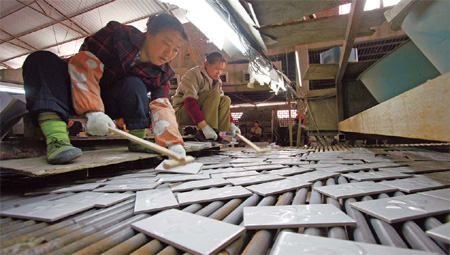
Workers at a ceramics tile factory in Jinjiang of Fujian province. The new import tariffs imposed by the EU in September on ceramic tiles made in China will keep more than 1,000 Chinese exporters out of the European market, experts say. [Photo /?China Daily] |
China has been the biggest target in the anti-dumping investigations over 16 successive years and targeted most in anti-subsidy investigations over five successive years, officials said.
"China has become the biggest victim and first target of global trade protection," Song Heping, a specialist from the Bureau of Fair Trade for Imports and Exports of Chinese Ministry of Commerce, said.
"It has been targeted most in the anti-dumping investigations for 16 successive years (1995-2010) and targeted most in anti-subsidy investigations for five successive years (2006-2010).
"Trade frictions are not confined to limiting China's exports but more and more expanding to macroeconomic frictions including economic development strategies and policies."
Since 2002, the first year after China entered the World Trade Organization (WTO), the country was subject to 692 trade remedy investigations, including 510 anti-dumping investigations, 106 safeguard measure investigations, 43 anti-subsidy investigations and 33 special safeguard measure investigations, Song said.
The slowdown of the global economy and the shrinking demand in international markets add more pressures to China's foreign trade.
Song said the main economies, including the United States and countries of the European Union, are putting more effort to expand exports, because of weak domestic demand. The competition to gain increased market share and to internationalize their domestic industries is becoming fiercer, Song said. "And trade and investment protections and trade restriction measures are increasing."
On Oct 14, the Chinese Ministry of Commerce asked the WTO to set up an expert panel to deal with the long-running disputes over US anti-dumping measures against warm-water shrimp and diamond saw blades.
The US zeroed in these two cases, calculating penalties by considering imports priced lower than in their domestic markets, but excluding those priced above. The move violates WTO rules and damages Chinese companies' rights, the ministry said on its website.
In 2010, China became the second largest economy in the world and the biggest exporter, but trade remedy investigations targeting China account for 35 percent of the all such investigations in the world. And 10 out of 15 trade protection policies initiated in 2010 target Chinese commodities.
While investigations from the EU and the US remain high, emerging economies have been becoming China's main source of trade remedy investigations.
"In view of the number of trade remedy cases against China, emerging economies are now developing into China's main sources of trade remedy investigations," said Liang Hao, first secretary of Bureau of Fair Trade for Imports and Exports of the Ministry of Commerce.
In the first half of 2011, four countries of the BRICS (Brazil, Russia, India, China and South Africa) initiated seven trade remedy investigations against China worth about $780 million, about 37 percent of all the trade remedy investigations in the world. India led the four with 67 trade remedy investigations against China from 2007 to the first half of 2011, at a worth of $4.9 billion, Liang said.
From 2001 to 2010, 16 developing countries or regions in Asia and Africa initiated 324 trade remedy investigations against China, including 239 anti-dumping investigations, 70 safeguard measure investigations and 13 special safeguard measure investigations.
Major emerging economies are experiencing trade and industrial restructuring while the deteriorating global trade conditions reduce profits of export enterprises.
Kandeh K Yumkella, director-general of the United Nations Industrial Development Organization, told Xinhua News Agency certain developing nations with an endowment structure similar to China, like those in South America and Southeast Asia, experienced keener competition in labor-intensive exports and lower prices for their products.
Pu Lingchen, partner of Zhong Lun Law Firm, said over the next five to 10 years "anti-dumping investigations against China will keep going up. While India tops the list of investigations against China, more investigations will come from Latin America."
Liang said the members of Association of Southeast Asian Nations (ASEAN) will be China's main working area for coping with trade remedy investigations as "countries like Indonesia and Thailand have learned how to use anti-dumping and general safeguard measures to protect domestic industries".
In 2011, Thailand initiated trade remedy investigations against five types of China's exports.
Trade remedy investigations from emerging economies feature in anti-dumping with small amounts.
"The trade friction with emerging economies usually centers in certain industries like textile, metal minerals and chemicals. But the trade remedy investigations are expanding from primary products to high-tech products or downstream products and it becomes more and more complex to cope with these investigations," Liang said.
The government is working on a platform for better communications with trade remedy investigation origins.
"China has established a cooperation mechanism of trade remedy with eight countries including the Republic of Korea. The training and dialogue under the mechanism benefit China's enterprises in responding to trade remedy investigation," Liang said.
The South Korea launched no trade remedy investigations against China since 2003 owing to dialogue and meetings under the mechanism.
Li Yong, vice-president of Xiamen Overseas Chinese Electronic Co Ltd, said industrial associations should take the lead in coping with trade remedy investigations.
"It is not good for the government to take the lead in setting industry development strategies and coping with investigations. Industrial associations should shoulder the responsibilities but they have too few resources," said Li.
Related Stories
China's 10 Years in WTO 2011-12-01 14:43
China's WTO entry a 'great story' in world history 2011-12-01 14:37
Ex-US chief trade negotiator reflects on progress 2011-12-01 09:27
The face behind WTO saga still hard at work 2011-12-01 07:40
- Chinese shares close lower after data release
- Passengers prepare for annual peak
- Home appliance sales in rural China up 66% in Nov
- Collective wage talks promoted
- Good things in store for Chinese life insurers
- Dotcom could fall into disuse
- Global supermarkets conquer China
- China's Nov CPI up 4.2%, PPI up 2.7%