Foreign and private investors now contribute more than half of China's industrial output, the statistics bureau said yesterday.

Relaxed ownership rules in the manufacturing sector led to foreign and private factories contributing 53 percent of last year's industrial revenue, according to a National Bureau of Statistics (NBS) report released yesterday. The figure was 41 percent in 2002.
Industry is the backbone of China's fast-paced economy, despite the government's efforts to develop the country's agricultural and service sectors. In 2006, 43 percent of China's gross domestic product came from industrial expansion.
While it's seen rapid and stable growth in the industrial sectors, China has restructured its economy to increase the weight of its service sector. By 2006, the service industry accounted for 40.1 percent of the economy.
Industrial companies with foreign backing accounted for 31.5 percent of China's industrial revenue last year, up from 29.3 percent in 2002.
Measures to encourage the development of the private economy in recent years have seen private firms' industrial output increase at a faster pace. Private companies' contribution to China's industrial output increased from 10.7 percent in 2002 to 21.2 percent in 2006.
But the NBS report said yesterday that State-owned enterprises (SOEs) still play an important role in the sectors that are important to the country's economic security. For example, SOEs accounted for nearly 99 percent of economic output in the oil and natural gas exploration sectors, and the figure is 90 percent for the electricity industry.
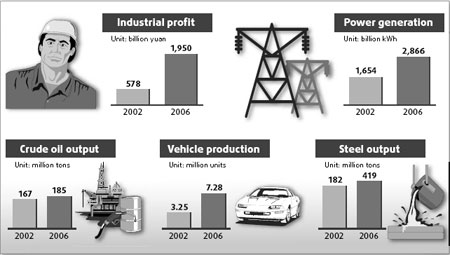
Increased investment has also seen the number of companies with annual revenue higher than 2 million yuan increase from 120,000 in 2002 to 300,000 last year, according to the report. It said foreign and private investors own 70 percent of the country's 300,000 industrial firms.
The number of SOEs affiliated to the central government has dropped to 155 from 196 since restructuring began in 2003.
The State-owned Assets Supervision and Administration Commission (SASAC) plans to cut the number of major companies under its control from 155 to between 80 and 100 by 2010. But Xinhua quoted SASAC researcher Wang Zhigang as saying the goal will be met by the end of next year itself.
The central government will also focus on developing 30 to 50 companies to better compete with foreign firms, Li Rongrong, minister of the SASAC, said recently.
He also said the companies under his supervision will concentrate on strategic industries like the military, electricity, petroleum and chemicals, telecom, coal, civil aviation and shipping.
"So far, SOEs have achieved a satisfactory performance in meeting the government's economic development goals," said Li, commenting on the role of the State assets regulator, which was set up in 2003 to take control of big SOEs by promoting mergers and acquisitions and allowing poorly performing State firms to go bankrupt.
Performance this year
China's industrial firms reported 1.56 trillion yuan of profits in the first eight months of this year, up 37 percent from a year earlier.
Profits of State-owned enterprises rose 31 percent to 680.1 billion yuan, while collective and foreign-funded firms posted 39.3 billion yuan and 418.4 billion yuan. Private companies' profits hit 260 billion yuan, up 48.5 percent compared with the same period last year.
Booming growth was primarily driven by soaring profits in sectors like steel, building materials and transport equipment, according to the NBS.

Steel firms saw their profits rise 58.9 percent from the same period last year, while profits of building material companies surged 64 percent and that of transport equipment makers went up 66.5 percent.
Lin Yueqin, a researcher with the Chinese Academy of Social Sciences, attributed rapid profit growth to the continued expansion of China's economy over the past few years.
"We have been gathering steam since 2003 and solid economic expansion has ensured profit increases," Lin told China Daily.
The economy has expanded at an average of 10.4 percent over the past four years - more than double the average growth rate of the world economy during the same period.
He said the fast growth has brought considerable improvement in the income and living standards of both rural and urban regions.
"This has sped up demand, and that in turn has accelerated industrial development," said Lin.