BIZCHINA> Center

|
BIZCHINA> Center
|
|
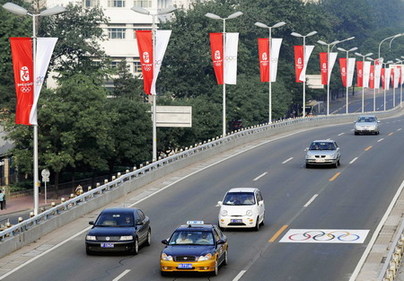
Fewer cars push Games to green lane
(China Daily/Agencies/Xinhua)
Updated: 2008-07-21 06:38 Beijing Sunday inched a step closer to realizing a green Olympics by enforcing a series of measures to ease traffic jams and reduce pollution. Vehicles with even and odd plates will hit the roads only on alternate days, which effectively means just half of the capital's 3.29 million automobiles can run on any given day. With more than 1,000 new cars being registered every day, Beijing is fast becoming one of the world's most congested cities. But the traffic restrictions will hopefully make another 4 million people use public transport.
There were fewer vehicles on the roads Sunday and people found it easier to drive after the even-and-odd license plate rule was enforced. It will be in force till Sept 20, when the Paralympic Games ends. On a normal day, a drive from Liuliqiao Bridge, on southwest Third Ring Road, to Beitucheng, on the northeast, would take more than an hour. But Sunday morning it took only half an hour. Beijing residents are eager to use public transport if it's fast and comfortable. For instance, Lin Fengjiang, whose vehicle has an odd license plate number, took a bus because of the restrictions. "It's okay with me. Buses are running very fast today. They're more time-efficient." Yao Zhenping, assistant to the general manager of the Beijing Public Transport Holdings Group, said more than 95 percent of the buses ran on schedule Sunday, which is impossible on normal days of traffic congestions. The city authorities said the restrictions, along with an earlier ban on the use of vehicles that had failed to meet emission standards, could keep up to 2 million vehicles off the roads.
Pollution has been one of the biggest problems for the Olympics organizers, who are banking on the traffic and industrial restrictions to ensure blue skies for the athletes and other visitors, especially because car emissions are the major source of air pollution in Beijing. He Kebin, a professor at the department of environmental science and engineering of Tsinghua University, said Beijing had met almost all major indicators of air quality for the Olympics, except that for the inhalable particulate. "Vehicles account for more than 50 percent of inhalable particulate, and traffic restrictions are the most effective way to deal with it," He said. Environmentalists estimate that the even-and-odd number plate rule and the ban on vehicles that failed to meet emission standards would cut emissions by 63 percent. The city authorities have warned drivers not to flout the even-and-odd plate rule because hi-tech surveillance cameras can easily detect their numbers, and once caught they would be fined heavily. More than 10,000 "smart devices", including cameras and electronic detectors have been installed on major roads and dozens of designated Olympic routes. Taxi drivers, who loose valuable time and money because of traffic jams, have welcomed the traffic restrictions. "See, the traffic is already so much better, it's much easier to drive today," said a smiling Han Jianguo from behind the wheel of his cab. But ordinary Beijingers who will have to cope with the already-crowded public transport were not all so thrilled. Some richer ones, however, have bought a second car. "The rules will certainly help (ease congestion). But it will create some real difficulties for ordinary people," said a city resident, Liu Shuo. A series of regulations to check emission from factories in and around Beijing, too, went into effect Sunday. More than 150 high-polluting cement and other factories will be closed for two months. Tianjin, a port city east of Beijing and host to the Games' soccer qualifying matches, has ordered 40 factories to close down temporarily. And the industrial base of Tangshan, northeast of Beijing, will shut down nearly 300 factories this month. Beijing has spent about 120 billion yuan ($17.58 billion) to clean the environment. (For more biz stories, please visit Industries)
|
|||||
主站蜘蛛池模板: 成人亚洲av免费在线| 国产精品天堂蜜av在线播放| 精品国产高清中文字幕| 天天爽夜夜爽视频精品| 东京热一精品无码av| 熟女丝袜美腿亚洲一区二区三区| 狠狠色噜噜狠狠狠狠777米奇| 亚洲中文无码av永久app| 亚洲综合另类小说专区| 国产午夜福利精品视频| 丁香色欲久久久久久综合网 | 久久91这里精品国产2020| 婷婷色香五月综合缴缴情香蕉| 久久久久99人妻一区二区三区| 国产精品老熟女免费视频| 欧美性XXXX极品HD欧美风情| 妇女自拍偷自拍亚洲精品| 亚洲中文久久久精品无码| 天天看片天天av免费观看| 久久精品国产精品亚洲综合| 噜噜噜亚洲色成人网站∨| 亚洲色图狠狠干| 久久亚洲精品中文字幕波多野结衣 | 两个人的视频www免费| 亚洲精品第一在线观看视频 | 亚洲天堂网中文在线资源| 大地资源中文在线观看西瓜| 精品人妻系列无码天堂| 午夜不卡欧美AAAAAA在线观看| 最新系列国产专区|亚洲国产| 日韩高清亚洲日韩精品一区二区| 国产成人禁片在线观看| 国产精品综合在线免费看| 国产三级精品片| 韩国 日本 亚洲 国产 不卡| 久久久这里只有精品10| 亚洲男人天堂2018| 伊人久久综合无码成人网| 国模粉嫩小泬视频在线观看| 亚洲AV日韩AV永久无码电影| 男女做aj视频免费的网站|