BIZCHINA> Industries

|
BIZCHINA> Industries
|
|
Energy: Mixed energy forecast
By Ou Lu (China Daily)
Updated: 2009-02-09 08:01
Support for China's non-thermal energy industries appears to have gone up last year, not down, contrary to the assumption that the global credit crunch would dampen investment as well as energy demand. However, many observers believe the picture may not stay as rosy this year if the government fails to lend official support to solar power and establishes global standards when it comes to wind power. Nuclear energy, however, is getting a big green light. Statistics released by the China Electricity Council (CEC) early last month showed that last year's investment by the clean energy industries, especially for hydropower, nuclear power and wind power, went up by large margins against a global economic slump.
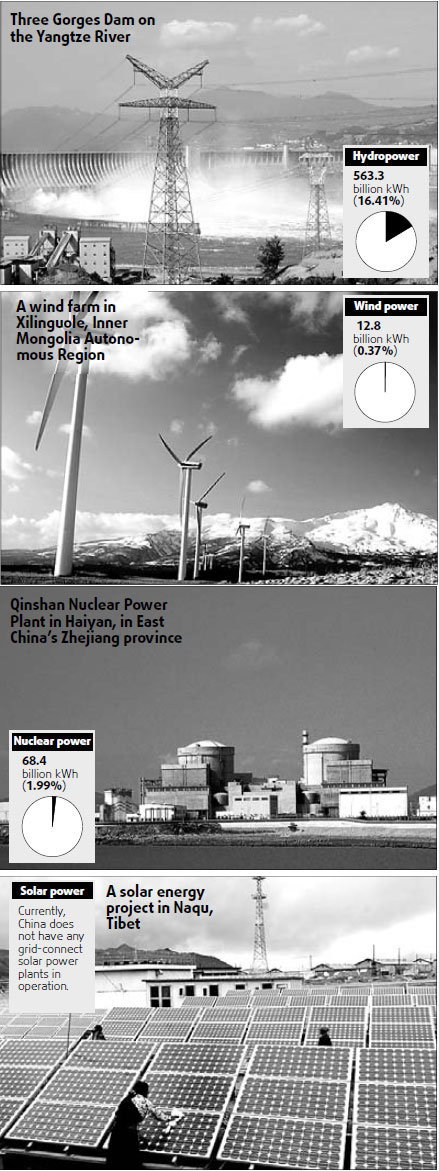
However, low crude oil and coal prices may make the pursuit of alternative energy less attractive. "People might still have some interest in the renewables, but they are no longer crazy about them. The economic crisis will cause a decline in renewable energy project activity through 2009," said Zhou Tao, analyst with Great Wall Securities. Doubled by the fact that China's energy demand went down dramatically as the global financial crisis slowed the economy, the "disadvantage" of costly clean energy would loom larger, said Zhou. China's electricity consumption fell 8.6 percent from a year earlier in November and 3.7 percent from the same month the year before in October - its first such decline since 1999. "In addition, they will be facing difficulties in raising funds from the lackluster stock market as well as the banks, which are tightening lending rules," Zhou said. Good news is that the Chinese government recently promised to offer more support to the renewable energy industry. A plan will be issued in the first half of this year for subsidies for power generation projects based on renewable energy in the second half of 2008, according to Huang Shaozhong, an official with the State Electricity Regulatory Commission of China. From October 2007 to June 2008, subsidies of nearly 2 billion yuan were provided to 148 renewable energy projects. The financial crisis has brought down prices and demand of raw materials, such as steel and silicon. "This is good news for the wind turbine and solar panel manufacturers," Zhou said. Hydropower Last year marked a milestone in the development of China's clean energy industry. The capacity of newly installed hydropower systems, about 20.1 gW, peaked in 2008 and the use of large hydropower systems in China grew by 19.5 percent, accounting for around 16.4 percent of the country's total output. China's coal-fired power plants are still the major power generator, contributing about 80 percent of the total supply. In addition to China's large hydropower stations, such as the Three Gorges project, Longtan project and Xiluodu project in southwestern China, the country also gets a significant portion of its electricity from tens of thousands of small hydro stations in rural areas. In 2008, there were 50,000 such micro-hydro stations in China, supplying one-quarter of the population with electricity. Nuclear power Zhang Guobao, head of the National Energy Administration, told People's Daily a couple of weeks ago that the country would devote more efforts to boost nuclear power sector in the years to come. "Nuclear power is an ideal option to improve our energy mix," he said. The current installed capacity of nuclear power is about 9 gW, or 1.3 percent of total installed electricity generating capacity. It provides 2.3 percent of China's power. The country's goal is a total installed capacity of 12.1 gW. This year China will start building four nuclear power plants in Haiyang, Rongcheng in eastern Shandong province, Sanmen in eastern Zhejiang province, and Yaogu in southern Guangdong province. According to a statement Zhang made earlier in 2008, China would try to raise the proportion of it nuclear power to 5 percent of the total installed generating capacity by 2020, up 1 percent from the goal set in 2006. Wind power Domestic wind power generation capacity grew by 4 gW to 10 gW in 2008. China's wind power investment is growing at a rate that is the second fastest in the world, only after the US, according to Zhang. And the goal to raise its total generation capacity to 100 gW by 2020 seems more achievable. But problems are blowing in the wind. Data from CEC showed that wind accounted for 1.1 percent of the overall power generation capacity in the country last year and a meager 0.3 percent of its total electricity generation. For the moment, production from turbine makers and investment by remote generators is moving far swifter than the grid. China is also slow on reaching global standards for turbine efficiency, but should overcome this because its wind-power industry produces several world-class turbine manufacturers. Though Chinese law requires the country's two state-owned power grid operators to provide connections and buy up all renewable energy, they have been slow, especially as wind farms are often remote and wind power generation fluctuates, depending on the weather. "China's concession bidding model prefers a low-price-bidder-wins system, so China will not get reliable quality wind farms to do it," said Michael Eckhart, president of the American Council On Renewable Energy. "You have to evaluate the bids for quality and give awards based on quality but not just the lowest price," he said. In the same statement made to People's Daily, Zhang promised that China will soon create a "favorable policy" to spur the birth of big wind farms and to connect them to big power grid. Large-sized wind farms are being planned at Gansu, Hebei and Jiangsu provinces as well as Inner Mongolia autonomous region. Solar power chills The absence of incentive policies for the solar power industry is also be the major problem that holds back its development. "The government has showed their support for the wind industry, but it never did so for the solar industry," State Council counselor, Shi Dinghuan, said in November. "Without an articulate and practical pricing mechanism for on-grid solar electricity or government subsidies, solar electricity will not have a market here in China. The Chinese government detailed its incentive policies for the wind industry in its new Renewable Energy Law and it also set an ambitious target to have 30GW of wind power by 2020. "The Renewable Energy Law has been effective for two years, but it has not really benefited the solar power industry," he added. According to Eckhart, the United States government passed an investment tax credit for solar energy in October and extended that for eight years. "This kind of long-term commitment is good and all governments should do it like this," he said. Statistics shows that there are more than 70 grid-connected photovoltaic projects in China, but only two of them received feed-in tariffs, and most of them have not benefited through the Renewable Energy Law. (For more biz stories, please visit Industries)
|
||||||
主站蜘蛛池模板: 欧美激情一区二区三区高清视频| 国产一本一道久久香蕉| 欧美最大胆的西西人体44| 最新的国产成人精品2020| 国产成人不卡一区二区| 日本亚洲欧洲无免费码在线| 麻花豆传媒剧国产mv的特点 | 亚洲中文在线视频| 国产视色精品亚洲一区二区| 久久中文字幕日韩无码视频| 亚洲精品日韩中文字幕| 精品人妻日韩中文字幕| www国产精品内射熟女| 精品无码国产污污污免费| AV人摸人人人澡人人超碰| 亚洲国产中文字幕在线视频综合| 国产亚洲精品VA片在线播放 | 亚洲一区二区三区高清在线观看| 国产一级精品在线免费看| 国产男女猛烈无遮挡免费视频网址| 久久这里只有精品少妇| 99热精品毛片全部国产无缓冲| 浮力影院欧美三级日本三级| 精品国产成人亚洲午夜福利| 久久婷婷大香萑太香蕉AV人| 国产美女永久免费无遮挡| 国产精品亚洲一区二区三区喷水| 国产日产欧洲无码视频无遮挡| 亚洲成人av在线资源| 人妻日韩精品中文字幕| 国产不卡一区不卡二区| 国产69堂免费视频| 日韩一区二区三区女优丝袜| 精品久久久久久无码免费| 我被公睡做舒服爽中文字幕| 日本一区二区三区免费播放视频站| 国偷精品无码久久久久蜜桃软件| 深夜免费av在线观看| 公与媳妻hd中文在线观看| 亚洲av天堂综合网久久| 蜜桃在线免费观看网站|