BIZCHINA> Top Biz News

|
BIZCHINA> Top Biz News
|
|
West China still struggling
By Tan Yingzi (China Daily)
Updated: 2009-07-14 07:42
Despite massive exploitation of its natural resources and efforts made via the Go West Campaign, the economy of West China still lags behind the rest of the nation, experts said as the latest Blue Book of the Western Region of China was released. The book, a report on economic development in the western region, has been published annually since 2005. It reveals that while the area has seen a spike in projects that tap into its hydroelectric and metal ore potential, it has not yet closed the gap on wealthier provinces and remains the poorest region. "The reform of our financial system is the best way to bridge the widening gap between the western and eastern parts of the country," said Yao Yang, deputy director of the China Center for Economic Research at Peking University. 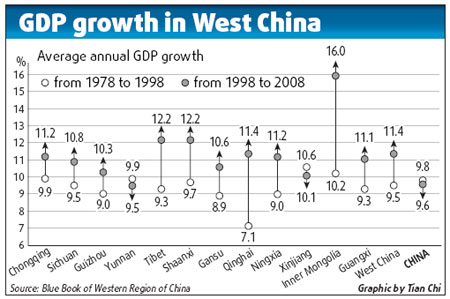 Yao said additional regional banks and a local capital market would encourage more investment in the region. Cai Jimin, deputy director of the Institute for Economic Research at Tsinghua University, said the exploitation of West China's rich natural resources has not translated into a financial windfall "because of the unreasonable tax system of natural resources and low compensation standards".
In recent years, West China has experienced its fastest period of economic growth since the founding of the People's Republic in 1949. The region is enjoying an average annual GDP increase of 11.42 percent, which is higher than the country's average of 9.64 percent. In 1999, West China's GDP increase was just 7.2 percent. And West China's average GDP per capita has doubled in recent years from 4,122 yuan ($600) to 13,186 yuan ($1,933). The average disposable income per capita has also increased, from nearly 6,000 yuan in 1999 to 11,309 yuan in 2007, the report says. But the region's GDP was only 17.8 percent of China's total in 2008 and its average GDP per capita was only 41.09 percent of that in the east. People in West China, despite the improvements, are earning less than the country's average. Eight western provinces were among the 10 lowest income areas in 2007. Gansu province had the lowest average income - people there earned 42.34 percent of the average income in Shanghai. The Blue Book was compiled by the Centre for Studies of China Western Economic Development at Northwest University in Xi'an, Shaanxi province. China initiated its western development strategy in 1999 to boost the underdeveloped area, which includes 12 provinces, autonomous regions and Chongqing municipality.
Policies such as heavy government investment, preferential tax rates and flexibility have been implemented to boost local infrastructure and environment. In the past decade, nearly 1.74 trillion yuan has been poured into 102 major projects. The annual growth rate in investment in fixed assets is more than 20 percent. But it lags behind, in part, because of historic underdevelopment, the report says. Further advances are planned for the next 10 years, said Li Yingming, deputy director of the Department of Western Region Revitalization under the National Development and Reform Commission. Three regional economic zones, the Guanzhong-Tianshui, Beibu Gulf and Chengdu-Chongqing zones, will spearhead its development, Li said. (For more biz stories, please visit Industries)
|
主站蜘蛛池模板: 日韩精品中文字一区二区| 亚洲中文久久精品无码| 欧美黑吊大战白妞| 总裁与秘书啪啪日常h| semimi亚洲综合在线观看| 2021av在线天堂网| 久久综合色最新久久综合色| 日韩有码中文在线观看| 啦啦啦高清在线观看视频www| 中文丰满岳乱妇在线观看| 久久综合国产精品一区二区| 中文字幕av无码免费一区| 欧美www在线观看| 免费人成网站视频在线观看| av一区二区中文字幕| 日韩av一区二区三区不卡| 精品国产女同疯狂摩擦2| 国语精品自产拍在线观看网站| 久久久网站| 久久久精品2019中文字幕之3| 国产精品色悠悠在线观看| 日韩av在线一区二区三区| 精品一区二区不卡免费| 人人妻人人狠人人爽天天综合网 | 伊人天天久大香线蕉av色| 午夜福利一区二区三区在线观看| 一区二区不卡99精品日韩| 日韩午夜午码高清福利片| 国产精品无码午夜福利| 亚洲最大成人av在线| 亚洲色成人一区二区三区| 韩国精品一区二区三区| 国产jlzzjlzz视频免费看| 成人拍拍拍无遮挡免费视频| 国产午夜福利精品久久2021| 不卡一区二区三区四区视频| 亚洲成a人无码av波多野| 国产成人精品无码一区二区老年人 | 激情国产一区二区三区四区小说| 久久综合噜噜激激的五月天| 久久精品国产亚洲av麻豆软件|



