Statistics
Fewer high school grads fight for university place
By Chen Jia (China Daily)
Updated: 2011-05-04 15:09
 |
Large Medium Small |
 |
|
High school students read university enrollment information at a consultation fair in Nanjing, capital of Jiangsu province, in this file photo from July 2010.?[Photo/China Daily] |
BEIJING - A smaller number of students will take the national college entrance examination in 2011 than did in past years, according to a report released by a website run by the Ministry of Education.
The site, Eol.cn, suggested the trend of fewer people taking the test is likely to continue until 2020. The reduced interest in the test, which is the benchmark by which students are admitted to university, is likely to have an impact on the financial situation of some of the nation's universities.
"Around 110,000 students took the national college entrance examination in Beijing in 2006 and this year is the sixth consecutive year that the capital has seen a smaller number of students take the exam," said Xu Chongren, chief of the Beijing-based admissions office of Peking University.
A similar picture was seen in at least eight provinces and municipalities around the country.
| ||||


The total number of students sitting the examination in 2011 has not been finalized because the application process is continuing.
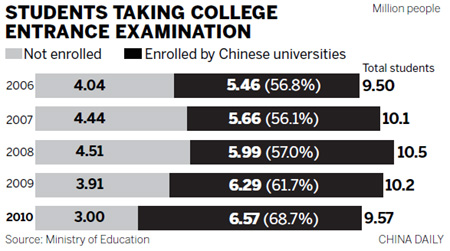
About 9.57 million people, mostly high school graduates, sat the three-day exam in 2010, 650,000 less than in 2009.
The peak nationwide came in 2008, when 10.53 million candidates sat the exam, according to the Ministry of Education.
The falling birth rate and growing popularity of overseas educations have combined to pull down the number of people competing to get into China's universities.
According to education ministry statistics, primary school enrolment has decreased since 1996. There were about 139.54 million primary school students in 1998, and the figure decreased by 30 percent to 100.72 million in 2009.
The report said such a drop leads to a decrease in the number of people taking the college entrance examination.
The number of Chinese students studying overseas has increased by 25.8 percent every year on average since 1978 and the number reached 284,700 in 2010, according to education ministry statistics.
The report said high school graduates do not make up a large proportion of students studying overseas, most are doing master's degrees, but the proportion continues to grow.
"Today's high school students no longer have to face fierce competition to fight for a university place," said 30-year-old He Ling, who works for the human resources department at a Beijing-based company.
"But university graduates will not be as competitive in the job market as before. The job market is starting to devalue newcomers with a higher education."
Chinese parents have become more accepting of their children not pursuing a university education because of rising employment pressure.
"I encouraged my son to pursue a place at a top-level vocational school, rather than a second-level university, because a vocational education will help him more," said a Beijing taxi driver surnamed Wang.
The decreasing number of college entrance exam candidates has intensified competition among Chinese universities to lure the best brains.
Nanjing University of Technology has promised 15,000 yuan ($2,300) to applicants who beat their provincial entry scores by 100 marks.
Some universities are promising the best applicants the pick of any major and the chance to continue their postgraduate studies without taking additional exams.
| 分享按鈕 |