Opinion
Sustainability through renewable energy
By Bernhard Raninger (China Daily)
Updated: 2011-05-10 14:16
 |
Large Medium Small |
China's 12th Five-Year Plan (2011-2015) shows that it wants to become the world's future green superpower. The implementation of ambitious ecological policy targets will contribute to the overarching goal of reducing carbon dioxide emissions per unit of GDP by 40 to 45 percent by 2020 from the 2005 level.
The targets include increasing the amount of non-fossil energy by 15 percent, saving energy in buildings, increasing energy efficiency in transportation and industry, preventing environmental pollution from urban, agricultural and industrial sources, and extending the principle of circular economy in energy and material management.
With its still very low average ecological footprint of about 2 acres for one person's sustenance, China is in a good starting position compared to the United States, which has an average of 24 acres. But the tendency to copy the "American way of life" with its potential social and ecological disadvantages is strong among Chinese people, a path they have to steer clear of.
| ||||


One thing needed to solve all these problems and develop a proactive public contributing behavior is awareness among the people. China is the only country that has been controlling its population growth for three decades and thus contributing to global stability. Chinese people recycle secondary row materials and save resources extensively, even if to save money.
But there is more that they can do. For instance, they can redesign industrial processes to avoid waste generation and reduce pollution, and better integrate material and energy resources among different industrial sectors. Chinese households have to separate their waste at source, something that people in many European countries do. More integrated ecological network thinking is needed to understand why, for example, simply separating biodegradable waste in households is a valuable contribution to energy security, environmental protection and reducing greenhouse gas emission.
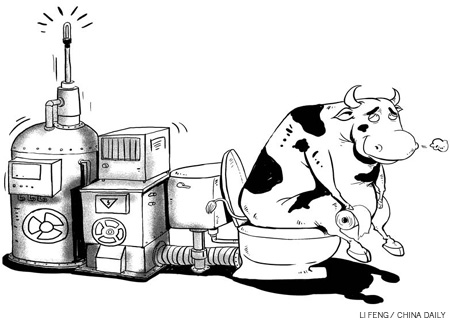
With its abundant biomass and organic waste resources, ranked highest in the world, China has the potential to replace 1 billion tons of coal, which is one-third of its current consumption, with biomass-based energy. The latest comparable figure in Germany is 23 percent of primary energy generated from biomass in 2050.
Biogas and other forms of biomass-based energy from solid (wood, pellets, rice husks) and liquid biofuels (bio-ethanol, bio-diesel) can replace fossil fuel, such as coal and natural gas, and nuclear energy. Biomass fuels have the big advantage of not being dependent on weather conditions like wind and solar power and thus are more reliable and stable. They can be stored and made available on demand more easily, and thus qualify as controllable basic supply services. This characteristic has not been fully recognized and, therefore, biomass-based energy remains underdeveloped and undervalued.
Following the best international models since 2005 - applied in Germany - research has been carried out at the Institute of Clean Energy and Environmental Engineering of Shenyang Aerospace University in Liaoning province to see if using agricultural and urban organic waste as sources for renewable biogas generation is possible. The average collection of biodegradable waste in the pilot areas, with 60-70 percent participation, was 80 kg per capita per year. The biogas generated from that 80 kg of biowaste will be enough to run a car for at least 600 km. But such waste is dumped into landfills at present.
Waste incineration does not generate the potential amount of energy from garbage. To get the potential amount of energy from waste it is necessary to separate "dry" and "wet" waste at source. This system was recently introduced in about 3,000 residential communities in Beijing, and in Shanghai, Guangzhou, Shenyang and Harbin. Dry waste can then be incinerated or converted into fuel energy. Wet waste consists mainly of biowaste and can be used to generate biogas.
Managing sustainable energy supply in China is very important. The still high demand for traditionally operated centralized power supply is confronted with a newly built decentralized distributed energy supply system, based mainly on local renewable sources with small generation units. The challenge is to combine 600-megawatt coal-power plants with some kilowatts from solar panels, smaller wind turbines and mid-sized biogas plants.
According to the National Development and Reform Commission's (NDRC) "Medium and Long-Term Development Plan for Renewable Energy in China in 2007", by 2020 at least 3-gigawatt grid-connected electricity should come from middle- and large-scale biogas plants.
The NDRC has acknowledged that 1 billion tons of coal can be replaced by biomass-based energy by 2050. It is to be hoped that the 12th Five-Year Plan enforces integrated concepts and the use of agricultural, municipal and industrial biomass for energy generation. Modern reliable technologies based on international standards can boost the development of this sector and the goals of China's national renewable energy agenda can be reached more easily and economically.
Biomass-based energy can even help replace nuclear power plants which, however we build and operate, will pose a serious threat to and create an unsustainable burden for future generations because of its radioactive waste.
The author is a professor at the Institute of Clean Energy and Environmental Engineering at Shenyang Aerospace University and China Agriculture University. He is the director of the Sino-German GIZ Biomass Utilization Project of the Chinese Ministry of Agriculture.
| 分享按鈕 |