Timetable for reducing hazardous pollution
Updated: 2011-12-22 08:39
By Li Jing (China Daily)
|
|||||||||||


BEIJING - The Ministry of Environmental Protection on Wednesday laid out a detailed timetable for Chinese cities to monitor the smallest and most hazardous airborne pollutant, known as PM2.5.
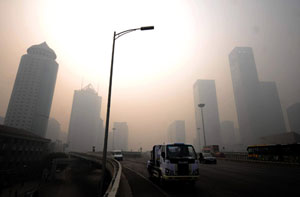
Such particulate matters - smaller than 2.5 microns in diameter - can travel into the lungs and damage people's respiratory systems. Currently, China measures air quality based on the larger pollutant PM10, which fails to gauge air quality accurately and has resulted in widespread public complaints in recent months.
"The new air quality standards - those including PM2.5, ozone and carbon monoxide - should be published as soon as possible," Minister of Environmental Protection Zhou Shengxian told a national meeting on Wednesday.
Cities in the Beijing-Tianjin-Hebei region, Yangtze River Delta and Pearl River Delta, as well as Southwest China's Chongqing municipality and provincial capitals, are requested to monitor PM2.5 and ozone starting in 2012, according to Zhou.
The country's 113 key environmental protection cities will have to start monitoring PM2.5 in 2013, while all county-level cities should follow the rule by 2015.
"The deadline is Jan 1, 2016. By then the new air quality standards will apply to the whole country, and the monitoring results should be made public."
However, he did not make specific requests for cities that monitor PM2.5 before 2016 to publish those readings, which is disappointing some environmentalists.
Zhou Rong, an energy and climate campaigner from Greenpeace China, said monitoring and reporting PM2.5 levels as soon as possible are crucial to addressing the fine particulate pollution problem.
"It is true that publishing the readings will not help to resolve the pollution overnight, but at least the public can have a clear idea about the pollution level and better protect themselves," she said.
Meanwhile, Minister Zhou also warned of the grave situation the country is facing in meeting its own pollution emission reduction targets.
In the first nine months of this year, China saw a 7.2 percent hike of its nitrogen oxide emissions - which stems mainly from coal-fired power plants and vehicle exhaust, despite the yearlong target to reduce the pollutant by 1.5 percent.
The emissions of ammonia nitrogen, a major water pollutant, was only reduced by 0.9 percent, which will also fall short of this year's target of a 1.5-percent drop, according to Zhou.
"The overall environmental quality is still degrading, and we're facing more challenges to meet the emission reduction targets for the next four years," he said.
From 2011 to 2015, China plans to reduce emissions for nitrogen oxide and ammonia nitrogen by 10 percent below 2010 levels, and cut sulfur dioxide and chemical oxygen demand by 8 percent.