China will step up its efforts to develop seven strategic emerging industries to fight downward pressure on the economy and upgrade innovation capacity, but experts warned of overinvestment and overcapacity in these areas.
The government wants the seven strategic industries to generate 8 percent of China's GDP in 2015 and 15 percent by 2020, said Zhang Xiaoqiang, vice-minister of the National Development and Reform Commission, in an online interview on Monday.
China unveiled a national development plan for strategic emerging industries during the 12th Five-Year Plan (2011-15) on Friday, which detailed 20 major projects that it wants to focus on during the period, such as the Broadband China program, new flat-panel displays and cloud computing.
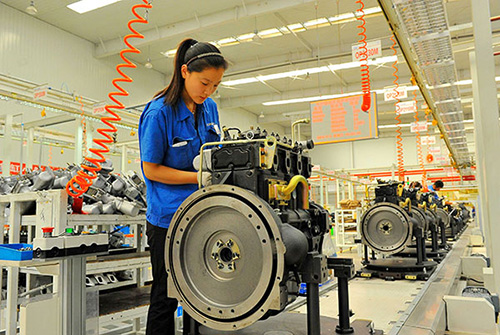
To speed up economic restructuring, the country unveiled plans to develop seven strategic emerging industries in 2010- energy saving and environmental protection, new-generation information technology, biotechnology, high-end equipment manufacturing, new energy, new materials, and new-energy vehicles.
The seven strategic sectors accounted for less than 4 percent of GDP at the end of 2010.
Saving energy and protecting the environment are listed as chief concerns.
"The fast industrialization and urbanization in previous years have consumed a large amount of energy and had an adverse effect on China's environment, so we have made this a top priority," Zhang said.
Developing strategic industries will play an important role in helping relieve downward pressure on the economy during a negative economic outlook, said Zhang.
China's economy grew at 7.6 percent in the second quarter, its slowest pace in three years. Some analysts expect the government to launch stimulus policies.
Wan Jun, a researcher of the Institute of World Economics and Politics, at the Chinese Academy of Social Sciences, said a slower economy needs fresh driving forces, but massive investment in emerging industries might be unwise.
"Growth rates in traditional industries such as steel, automobile, real estate and chemical all plummeted, and the nation hopes emerging industries can play a leading role in economic development," Wan said.
However, unlike traditional industries, emerging industries face huge uncertainties in their development. Technologies like those used in electric vehicles could become outdated quickly, and it will take time to commercialize technologies and nurture the market, he said.
Policymakers must transform ways of thinking, as the successful development of emerging industries won't rely solely on new building, as was the case during the development of the chemical industry in the past decade, he said.
Also, overcapacity has emerged in emerging sectors such as wind power.
At the same time, the government must position itself well in the development of emerging industries, he added.
Public investment should mainly focus on key common technologies that could be shared among companies. The government could also play a positive role in creating a favorable investment environment and launch pilot programs to help shorten the time it takes new products to be accepted in the market.
"The government should play only a limited role in the development of emerging industries. To make these industries really competitive and mature, market mechanism should play a decisive role," Wan said.
Strategic emerging industries are targeted to maintain an average annual growth rate of more than 20 percent, and the government will provide favorable fiscal and financial policies to boost their development.
Lin Boqiang, director of the China Center for Energy Economics Research at Xiamen University, said the planning showed the central government's preference for future investment, and local governments will follow suit to get their projects' approval.
Some provinces have announced a series of subsidy measures to support strategic emerging industries.
Companies in strategic industries can expect significant subsidies from the central government and local governments, experts said.
The central government has set up a 7.5 billion yuan ($1.17 billion) investment fund this year for strategic emerging industries, said Lin.
Reuters reported at the end of 2010 that China was considering investing up to $1.5 trillion in the seven strategic industries by 2015.
lanlan@chinadaily.com.cn

Copyright 1995 - . All rights reserved. The content (including but not limited to text, photo, multimedia information, etc) published in this site belongs to China Daily Information Co (CDIC). Without written authorization from CDIC, such content shall not be republished or used in any form. Note: Browsers with 1024*768 or higher resolution are suggested for this site.
License for publishing multimedia online 0108263 Registration Number: 130349