Comments()
  Print
Print  Mail
Mail  Large Medium Small
As a result of the worst drought to hit the United States in 56 years, pork prices are estimated to jump, slowing exports to China and other countries.
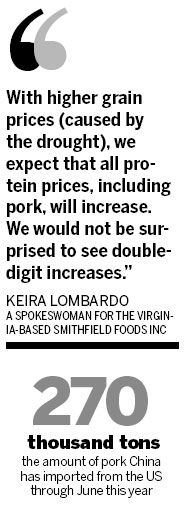
"With higher grain prices (caused by the drought), we expect that all protein prices, including pork, will increase," said Keira Lombardo, a spokeswoman for the Virginia-based Smithfield Foods Inc. "We would not be surprised to see double-digit increases."
Smithfield produces and processes more pork than any other company in the world, and is the largest US pork exporter to China, shipping about 1.1 billion pounds (499 million kilograms) of it in 2011.
As much as two-thirds of the contiguous United States - the "lower 48", excluding Alaska and Hawaii - has been scorched by severe heat this summer, the government estimates. That has caused crops to shrivel and led to forecasts of unusually low yields.
The Arkansas-based Tyson Foods Inc, one of the biggest US meat producers, announced earlier this month that its profit in its fiscal third quarter, which ended on June 30, decreased by 61 percent. Its earnings from its pork business alone fell by 44 percent.
"Grain costs have been increasing significantly and rapidly, largely as a result of the drought," said Donnie Smith, Tyson CEO. "While we ultimately expect to pass along rising input costs, these costs, coupled with continued soft demand, are likely to pressure earnings in 2013."
That scenario could be disastrous for pork producers and the livestock industry. While drought-ravaged crops threaten farmers with serious economic losses, a dearth of corn, soybean and hay could be even more harmful to raisers of livestock, said Chris Hurt, a professor of agricultural economics at Indiana's Purdue University.
"Normally, the first thought is that crop producers will suffer the financial loss, but losses in livestock industries will be enormous over the next year - perhaps considerably greater than for the crop sector," Hurt said.
He predicted that the US pork industry will begin losing money during the fall, and that its fortunes will continue to decline in the winter before hog prices rebound next spring and summer.
If the crop returns to normal in 2013 and there is no drought, feed prices will go down significantly, helping to ensure the industry can make a profit in the fourth quarter of 2013.
"The message for hog producers is that they must suffer the losses in the short run to have the opportunity to reach the potential financial rewards of the longer run," Hurt said. "Some will not have the financial stability to get through the short run (the next 12 months). Others are not willing to take the losses, and will reduce herd size."
China produces and consumes more pork than any other country and is the third largest importer of US pork products.
Erin Borror, an economist at the Denver-based US Meat Export Federation, said China imports specific items from the US mainly to supplement domestic production. When there's a shortage of pig's feet, stomachs or tongues, the US is able to supply these meats at relatively low prices.
Conversely, exports to China have helped US producers sell off excess supply that would otherwise depress prices at home. Any decrease in exports to China, whether it results from increases in feed prices or other causes, will make it difficult for the US pork industry to match the supply of its products to the demand for those products, Borror said.
The two countries' trade relationship in pork dates back 15 years and is now worth several hundred million dollars a year.
The amount has gone from 3,600 metric tons in 1997 to 77,000 metric tons in 2005 and a record of 375,243 metric tons last year, according to Wang Xiaoyue, an analyst with Beijing Orient Agribusiness Consultant Ltd.

 Michelle Obama addresses at Democratic National Convention
 Slides of Yanbian: place, people and prosperity
 Washington to remain focused on Asia-Pacific
 RQFII target blue chips amid bear market
 Australian recall for top two exporters
 China fears new car restrictions
Copyright 1995 - 2010 . All rights reserved. The content (including but not limited to text, photo, multimedia information, etc) published in this site belongs to China Daily Information Co (CDIC). Without written authorization from CDIC, such content shall not be republished or used in any form. Note: Browsers with 1024*768 or higher resolution are suggested for this site.
License for publishing multimedia online 0108263 Registration Number: 20100000002731