Confidence in China's future economy is mainly the result of continued government-guided regulation and innovation, said scholars and entrepreneurs at a symposium of the Annual Meeting of the New Champions 2012 in Tianjin on Sept 12.
|
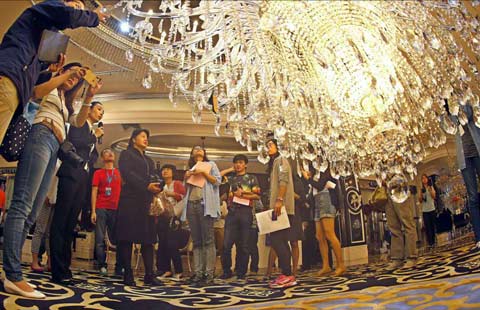
Scholars and entrepreneurs exchange insights at a symposium during the World Economic Forum's Annual Meeting of the New Champions 2012 in Tianjin. [Wang Jing / China Daily] |
But Lu Hongjun, president of the Shanghai Institute of International Finance, said the government should play "a different role in future economic regulation than what it played over the past three decades".
"There are three kinds of regulations the government can make," he explained. "Hard regulations like the 4 trillion yuan ($632.4 billion) stimulus plan are taken when desperately needed, and the effect is very powerful.
"Another kind of regulation is softer, basically providing guidelines for certain industries.
"But what's the most important is smart regulation," he said. "It is an invisible hand to guide and promote innovation from the bottom up."
James Turley, chairman and CEO of Ernst & Young, said "China is absolutely doing the right things along the right path".
"Having smart regulation - not no regulation - is what I'm nodding at."
Government regulation and the market are "two hands working cooperatively" to drive the nation's economy, said Zhang Bingjun, chairman of State-owned Tianjin TEDA Construction Group.
He said the government must take the lead in a number of industries such as infrastructure and new energy development because "there is actually no profit in the beginning and possibly over a very long period afterward".
"But in some other sectors, where there is full market competition, the government should loosen its hand and let the companies play," he said.
Liu Changle, CEO of Phoenix Satellite Television based in Hong Kong, said the government should first play the part of investor in key projects including infrastructure, major research projects and large-scale industries such as aircraft and aerospace industries.
Second, it should be the founder of market order, he said.
The nation's future economy should highlight technical and product innovation and new energy development, while paying more attention to western China, said Lu.
Emerging sectors
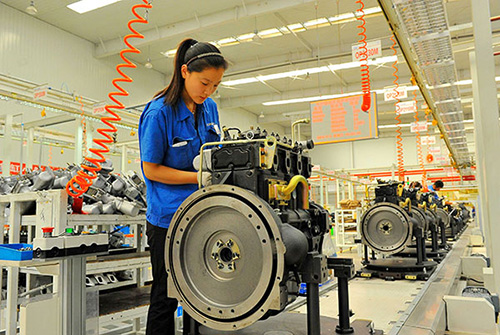
Seven emerging industries have been selected as strategic emerging industries by the State government, including environmental protection, new energy, new materials, bio-industries and high-end equipment manufacturing.
When companies are investing in those sectors, "to reduce risk, they should not act too fast or in too large a scale", said Liu. "Without upgraded technologies, large investment will lead to great waste and loss".
"The key element in the development of emerging sectors is expansion and development of lower reaches of the market," he said. "If the government just makes policies and guidelines blindly, and ignores the market, industries will lose vitality."
Knowledge economy
"Part of what will fuel China's future growth is the recognition that the industrial era will give way to the knowledge era," said Turley. "We see in the globalization drive a lot of value creation in intangible products, virtual assets and intellectual property - technology is certainly impacting all of them.
"What is going to drive China's growth is having a real, more open and free exchange of knowledge within and between companies. And it creates a cultural exchange when the people realize that knowledge is not to be held closed, but to be shared."
He said China has done "well as far as creating and securing patents, but less well in commercializing them".
Liu added that China's industrial transformation has come to the stage that the "labor intensive model is no longer the norm". Technology, innovation and education will play crucial roles at this time of transformation, he said.
zhangzhao@chinadaily.com.cn

Copyright 1995 - . All rights reserved. The content (including but not limited to text, photo, multimedia information, etc) published in this site belongs to China Daily Information Co (CDIC). Without written authorization from CDIC, such content shall not be republished or used in any form. Note: Browsers with 1024*768 or higher resolution are suggested for this site.
License for publishing multimedia online 0108263 Registration Number: 130349