Deleveraging will delay global economic recovery, so we have to find new ways to move out of unbalanced growth models
It appears that the world economy is tottering back into recession again despite the efforts of countries since the 2008 global financial crisis. A look at developed nations and emerging economies both gives the general feeling that the world economy is expected to continue its slowdown, and many forecasts of long-term growth have been dropping.
Responding to the crisis, central banks in the United States, and the United Kingdom and other European countries have almost exhausted their conventional and unconventional arms - from pushing interest rates close to zero to adjusting policy targets from inflation to growth and "creating" money by implementing quantitative easing.
However, it seems that recession cannot be rectified by lowering interest rates and increasing money supply alone, because the global economic contraction has been more structural than cyclical.
One of the most striking features of the recession is large-scale deleveraging. This has also been called a "balance sheet recession", reflecting a sharp contraction in real capital, for example, credit and equity, and shrinking balance sheets because of a shortage of capable capital providers and recipients. Faced with a massive fall in asset prices, companies and households are typically forced to minimize or restructure debts. As a result, they tend to reduce investment and consumption, leading to a general economic contraction.
This process of deleveraging could be painfully long, lasting a decade or more. During this period, debts must be reduced through bankruptcies, haircuts and other forms of debt restructuring, and companies may jettison their profit-making priority, lowering their break-even levels by cutting costs.
In a balance sheet recession, monetary policy is mostly ineffective in creating credit because interest rates hit zero and cannot be lowered further, while borrowers remain over-indebted, making credit-stimulation less possible. Instead, the ultra-low interest rates may cause some unwanted side effects. Usually, the level of interest rates can be viewed as a price affecting saving and investment.
Therefore, a negative real interest rate may discourage savings, and make enterprises reluctant to increase new investment.
If the rates are held at an artificially low level for too long, capital could be misallocated, fuelling financial speculation rather than entering the real economy. More worryingly, the effects in the advanced countries may have had spillover impacts on the emerging markets, pushing up exchange rates, causing asset bubbles and increasing commodity prices.
Specifically, interest rates have been an important instrument in calculating pension fund obligations in some developed countries. Given that interest rates on high-quality corporate bonds are used to determine pension funds' expected risk-free return, decreased rates mean that pension plans need more assets today to ensure they can generate sufficient investment returns to pay future retirees. That will place a burden on corporations despite the benefits generated from low interest rates and liquidity mitigation.
While recognizing the positive results from quantitative easing for stabilizing financial markets, there remains the issue of inflation related to the role of money. Central banks in some countries have pumped in lots of money to aggressively respond to the crisis, but the impact has been limited. Commercial banks have been slow to resume lending to businesses. And central bank action has made them believe that inflation might rise again.
The world economy will not get through a lost decade until the severe deleveraging ends. According to a market report by James Mackintosh in The Financial Times, as late as 1993, in the middle of a recession and two years after Japan's bubble burst, the International Monetary Fund had forecast that Japan's long-term growth would be on average 4 percent a year. Since then it has hit 4 percent only once, at the peak of the dotcom bubble. The private sector consensus is now for long-term growth to average 0.9 percent - that is a semi-permanent near-depression.
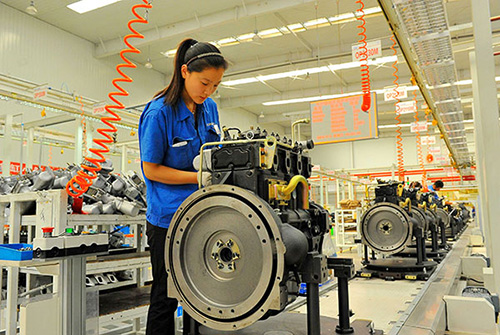
China's economy is in the process of a gradual and manageable slowdown, but the situation may be tougher than expected. China's manufacturing industry may deteriorate further because of a faster drop in new orders and an ongoing decline in export business. Against such a backdrop, Chinese banks have not increased credit as the market expected despite two interest rate cuts so far. In the meantime, the demand for credit has been diminishing remarkably.
Although some local governments are keen to launch a new investment stimulus package to maintain higher GDP growth rates, it will be impossible to implement them without banks' providing access to credit. Many local governments are over-indebted amid declining revenues (because of falling tax receipts and land sale revenues). In some cases, they are even asking enterprises to prepay taxes so that they can meet their expenditure targets.
After all, with the shortage of deposits, rising delinquencies, mounting stress in the real estate sector and manufacturing overcapacity, it is not surprising that Chinese banks have started sounding risk alarms and become more cautious about lending.
While inflation in China is not the immediate threat it was a few months ago, there is still doubt over how long the low consumer price index will last. Considering that pork prices are a key factor driving CPI in China, the increase in the prices of soybean and corn in the international market will affect domestic prices. So it is important to take measures to prevent a repeat of 2010, when inflation jumped to 6.5 percent.
These are times of economic uncertainty. The only thing we can be certain about is that deleveraging will drag on the global economic recovery, meaning a prolonged, painful process. To address a lost decade (or longer), we need to find new ways to move out of unbalanced economic growth models.
(China Daily 09/13/2012 page8)

Copyright 1995 - . All rights reserved. The content (including but not limited to text, photo, multimedia information, etc) published in this site belongs to China Daily Information Co (CDIC). Without written authorization from CDIC, such content shall not be republished or used in any form. Note: Browsers with 1024*768 or higher resolution are suggested for this site.
License for publishing multimedia online 0108263 Registration Number: 130349