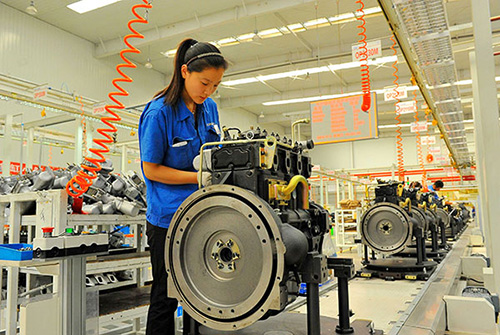
BEIJING -- China aims to become a world technological power by 2049 and strives to be a leader in innovation and science, according to a newly-released government guideline on its technological development.
The framework document sets the goal for the country to be "in the ranks of innovative nations" by 2020, urging efforts to deepen the reform of the scientific and technological system. It also aims to step up the building of a national innovative system so to lay a foundation for the country to become a technological power when celebrating the centennial anniversary of New China in 2049.
With China becoming the world's second largest economy, its leadership, who knows well that science and technology are prime productive forces, has strived to drive growth through technology.
The document puts forward new measures to spur technological development: enterprises should become pillar for innovation; supervision of research funds should be enhanced; outstanding researchers aged below 35 should be encouraged to lead scientific projects.
With the international economic meltdown continuing to unfold, China is at a key stage of transforming its development model. The country's overall technological strength and competitiveness have played a leading role in economic and social development and safeguarding of state security.
China's technological development faces both opportunities and challenges, as international competition and cooperation have become intense.
However, China's current technological system is not compatible with the demands of innovation and global competition. Its technological development has not been well integrated with the economy, facing problems such as fewer original scientific achievements, self-insufficient in key technologies and inefficient commercialization of research results.
Moreover, the innovative ability and enthusiasm of researchers have not been given full play, and some of them even lack scientific integrity. The aforementioned factors have contained China's technological growth and innovative efforts.
In order to grow into a global technological power, the releasing of the framework document ushers in a new round of reform for China's scientific and technological system.
This new round of reform is based on the initial success of the reform launched at the end of the 1970s when China started to open its door to the outside world. The principle of "economic development depending on technology" as well as the abandonment of a "big-pot" distribution system prompted the country's technological sector to enter the market economy and established many technological companies that played a major role in innovation.
Currently, the average R&D input for China's enterprises is only 0.74 percent of their revenues and the figure is 0.93 percent in large- and medium-sized enterprises, far below the level of 2.5 percent to 4 percent in developed countries.
The document has set the target for the average R&D input of large- and medium-sized enterprises to increase to 1.5 percent of their revenues during the 2011-2015 period. By offering incentive policies, the nation plans to nurture several leading assemblages of innovative companies.
The new round of reform of China's scientific and technological system is also based on the opportunity of global technological revolution and industry transformation.
To spur the creativity of scientists, China has changed the method of evaluating researchers which only focused on the quantity of thesis, projects and research funds. Instead, a comprehensive incentive mechanism has been implemented to enable scientists to concentrate on research.
Time is on the side of the Chinese people. The best and brightest should be given the autonomy to do their research. China needs patience and persistence in developing technology.

Copyright 1995 - . All rights reserved. The content (including but not limited to text, photo, multimedia information, etc) published in this site belongs to China Daily Information Co (CDIC). Without written authorization from CDIC, such content shall not be republished or used in any form. Note: Browsers with 1024*768 or higher resolution are suggested for this site.
License for publishing multimedia online 0108263 Registration Number: 130349