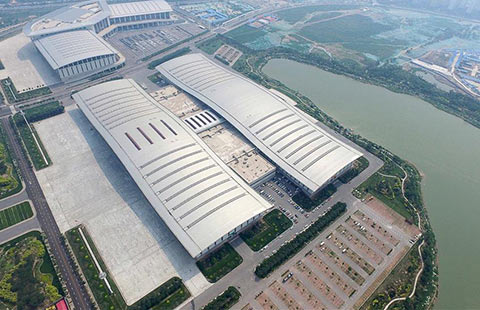
JINAN - In the commodity town of Linyi city, China's second-largest wholesale trade hub, Song Liansheng, a sporting goods dealer, finishes loading a truck with products to be shipped to another city within the province.
"Business so far this year is good. Sales have increased more than 10 percent from last year," he says.
Unlike Yiwu, the world-renowned export capital for knickknacks, Linyi is more oriented toward the domestic market. Located in East China's Shandong province, it annually dispatches thousands of freight vehicles delivering all sorts of goods to every corner of the country, as far away as Urumqi in the remote northwestern Xinjiang Uygur autonomous region.
Last year, the total trading volume of Linyi's market stood at 150 billion yuan ($23.75 billion). It is expected to surge to 200 billion yuan this year, according to the commodity town's administrative commission.
With these figures in stark contrast to some of China's key economic indicators, Linyi is bucking the trend of areas that are more reliant on exporting. It points to Chinese consumers' sustained demand for goods at a time when consumption in recession-battered traditional export markets is waning. Linyi is a perfect example of the inward-looking model that China may have to incline toward if its economy is to continue to grow healthily.
The country's economic growth in the first half of 2012 cooled to 7.6 percent, its lowest in more than three years. In August, the manufacturing purchasing managers' index dipped below 50, which demarcates expansion from contraction, for the first time in nine months, and stayed lower than 50 in September.
In the meantime, hurt by the sluggish global economy, exports remained weak, growing only 2.7 percent in August from a year earlier. China's stock market performance looks very dismal, too. It has kept hitting new lows, making investors' sentiments the most bearish ever.
"China's economic miracle is over" has become a catchphrase of Western media this year. Despite some experts arguing that the world's second-largest economy is unlikely to see a hard landing, those who are betting against growth in China seem to be gaining an upper hand.
However, merchandisers in Linyi do not look as gloomy as others do. Some exporters admit that their businesses were hit by the global headwinds, but they say they can bite the bullet and hold out.
Those who are focusing on domestic trade are expressing particular optimism. Business is running smoothly, they say, despite the government's controls on the property market weighing on sales of building materials and home products.
"No matter how tough the economy is, people still need to consume living necessities. Toothpaste, notebooks, basins, you name it. Don't forget that China has 1.3 billion people!" says Wang Shiling, who runs a large mall in Linyi, renting booths to hundreds of household product wholesalers.
Wang's remarks highlight an important point: China's huge domestic market presents enormous buying power.
"China is still in a strategic period of important opportunities," said President Hu Jintao when addressing the opening session of a workshop for ministerial officials and provincial heads in July.
In September, at the 2012 Summer Davos Forum, Premier Wen Jiabao also told the audience how industrialization, urbanization, information technology and agricultural modernization will enable China to unleash its huge potential, making explicit what the "strategic period of important opportunities" means.
Those who are pessimistic about China have obviously underestimated the strength and resilience of the world's second-largest economy, especially its domestic market. As reform goes further, China will gradually display its buying power to the full, while mobilizing other sectors.
Chinese are increasingly affluent. The per capita disposable income of urban households ballooned to 19,109 yuan in 2011 from 2,027 yuan in 1992, while the per capita net income of rural residents climbed to 5,919 yuan from 784 yuan. According to a World Bank report, China will become a middle-income country by 2020. At that time, its consumer worth will be stunning.
Meanwhile, development in the country's vast hinterland is set to fuel its economic growth. In recent years, manufacturers' drives to relocate their factories from costal China to less expensive interior provinces has boosted the economic vitality of the country's central and western regions. The moves have also offset higher costs, giving Chinese manufacturers an edge over their competitors on the global stage.
Ongoing urbanization will play a part as well. Last year, China's urban population exceeded its rural population for the first time in the nation's history, with city-dwellers accounting for 51.27 percent of the country's 1.347 billion people.
In 1981, only 20 percent of Chinese lived in cities. The country will see 300 million more urbanites by 2030, with 15 million to 20 million rural dwellers moving to cities every year, according to a forecast by the Organization for Economic Cooperation and Development.
All of the above will also drive the growth of investment, which has been and will continue to be one of the significant engines of China's economy. Inadequate infrastructure still hinders rural regions and the hinterland, while a yawning wealth gap calls for more spending on education, healthcare, social security, affordable housing and other areas to ensure social equality and improve people's livelihoods. In this context, it is a bit early to worry about over-investing. The key is where and how to make the investment.
Last but not least, China's economic fundamentals remain sound. Its debt levels, domestic consumption, employment and space of fiscal and monetary policies are much better than many countries caught in the crisis. That will give China more leeway to grasp Hu Jintao's "strategic period of important opportunities." And the economy will surely pick up steam.


Copyright 1995 - . All rights reserved. The content (including but not limited to text, photo, multimedia information, etc) published in this site belongs to China Daily Information Co (CDIC). Without written authorization from CDIC, such content shall not be republished or used in any form. Note: Browsers with 1024*768 or higher resolution are suggested for this site.
License for publishing multimedia online 0108263 Registration Number: 130349