BEIJING -- Those traveling by train used to have to spend almost an entire day or night in crammed compartments to get from Beijing to Shanghai, a distance equivalent to traveling from New York to Atlanta.
The then-grumbling travelers may never have imagined that a decade later an express railway would shorten the journey to less than five hours, even forcing airlines to cut flights between the two cities due to passenger losses after it was put into operation on June 20, 2011.
The 1,318-km Beijing-Shanghai High-Speed Railway, linking the nation's capital and its financial center, carries tens of thousands of passengers every day with high-speed trains travelling at some 300 km an hour.
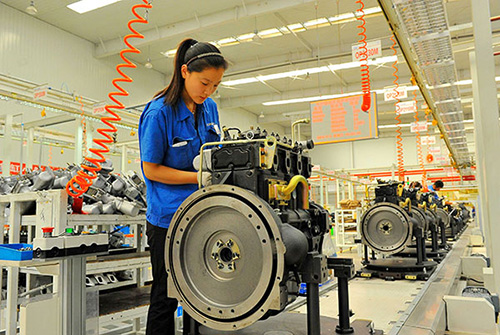
The express trains offer a glimpse into the development of China's high-end equipment manufacturing industries that have boomed in the past decade, led by high-speed railways, a satellite navigation system and a massive aircraft project, according to China Economic Weekly.
China currently has more than 6,800 km of high-speed railway lines operating at speeds of over 200 km per hour. The total length is expected to reach about 18,000 km by 2015, according to the Ministry of Railways (MOR), the report said.
After the first railway of this kind in northern China was put into operation in 2002, the country has twice raised its railway speed nationwide, in 2004 and 2007, respectively.
The high-speed railways have provided enormous impetus to the economy, the MOR said, citing the 2 million job opportunities created in regions along the Beijing-Shanghai express railway lines.
Experts estimate that the Beijing-Shanghai High-Speed Railway has boosted domestic demand up by nearly 1.2 trillion yuan (about $191.9 million) in the first two years of the construction period.
Analysts said that large-scale high-speed railway construction will be the engine for rapid growth in China's economy amid the global financial crisis and economic recession.
Apart from the rapid development of high-speed railways, the past decade has also seen the country's ambitions in high-end manufacturing reach into the aerospace sector.
Not long after the railway projects began to burgeon in 2002, in May 2003, China sent out its third geostationary satellite into space via its own carrier rocket, the Long March-3A, for the country's indigenous global satellite navigation system and positioning network, the BeiDou Navigation Satellite System.
The government embarked on developing the BeiDou system in 2000, aiming to break the dependence on the US Global Positioning System.
Between April 2009 and December 2011, a total of nine BeiDou orbiters were successfully launched into space.
Around the same time, a preliminary model of China's first home-grown large passenger aircraft, the C919, was unveiled at Airshow China 2010, three years after getting the green light from the central government upon the initiation of the country's civil aircraft project.
The manufacturer, the Commercial Aircraft Corporation of China Ltd, said that the company has now secured 13 customers and orders of 330 C919 units, and it expects the numbers to grow during the upcoming Airshow China, scheduled for November 2012.
Wu Guanghui, COMAC's chief designer for the C919 project, said that the future global and domestic markets will have a strong appetite for civil aircraft such as the C919.?" China will hand over more than 3,000 civil aircraft by 2029", a COMAC report forecast.
Likewise, the BeiDou system also aims high, setting goals of providing satellite navigation, time and short message services for Asia-Pacific regions by 2012 and global services by 2020.
Since it started to provide services on a trial basis on December 27, 2011, the network has been used in transportation, weather forecasting, marine fisheries, forestry, telecommunications, hydrological monitoring and mapping, according to the China Satellite Navigation Office.
The latest launch came in September, when the country put the 14th and 15th BeiDou satellites into orbit. By 2020, the system will consist of 35 satellites.
According to a document issued by the State Council, China's Cabinet, the development of high-end equipment manufacturing at the current stage will focus on aviation equipment, satellites, rail systems, oceaneering equipment and intelligent manufacturing. As the last two markets remain untapped, the clock is ticking.
Specifically, the sales revenue of oceaneering equipment, including equipment for offshore oil and gas extraction, is expected to reach 200 billion yuan by 2015, according to a government development plan released earlier this year.
The aggregated revenue of China's high-end equipment manufacturing industry totaled 1.6 trillion yuan in 2010, and the country expects the sector to become one of the pillar industries of the national economy by 2020.


Copyright 1995 - . All rights reserved. The content (including but not limited to text, photo, multimedia information, etc) published in this site belongs to China Daily Information Co (CDIC). Without written authorization from CDIC, such content shall not be republished or used in any form. Note: Browsers with 1024*768 or higher resolution are suggested for this site.
License for publishing multimedia online 0108263 Registration Number: 130349