|
 |
|
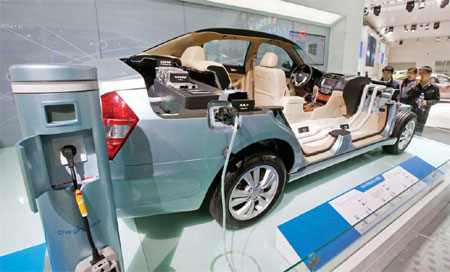
The second-generation electric vehicles of BYD on display at a recent car exhibition in Beijing. A Mckinsey report ranks the maturity of the Chinese EV market fifth in the world after Japan, the United States, France and Germany. Da Wei / for China Daily |
Report ranks Chinese market fifth in world for maturity and highlights barriers to growth
A recent Mckinsey & Company report on the maturity of the Chinese electric vehicle market has spurred discussion on Chinese EV performance and industry prospects.
The Mckinsey report ranks the maturity of the Chinese EV market fifth in the world after Japan, the United States, France and Germany.
While not everyone agrees with the report, it does reflect issues in the Chinese market.
Six indexes were used to evaluate the market's maturity level, including supply, market share, and research and development capabilities.
According to the report, 7,931 electric vehicles were delivered by US companies during the second quarter, up 28 percent on the first quarter, and 4,240 by Japan, but only 235 were delivered by Chinese companies, a drop of 31 percent on the first quarter's 343.
Yin Chengliang, deputy director of the National Engineering Lab, disagrees with the McKinsey ranking, citing EV maker alliances with local governments to deliver large scale pilot operations in parts of the country.
In Beijing, for example, EV maker Beijing Foton Motor Co supplied 250 electric cars to the government to be used as taxis. And in South China's Shenzhen, battery and EV maker BYD has been piloting operations of its e6 fleet for nearly three years.
But Yin admits there are few purchases from individuals in China, unlike in Europe and the US, due to high prices, safety concerns and lack of infrastructure.
Since the first two mass produced electric vehicles, the Nissan Leaf and Chevy Volt, rolled off production lines in 2010, most purchases in the US and Europe have been by individuals, while in China the major buyers are local governments and State-owned companies.
High prices also drive away potential customers, according to Yin. The Chevy Volt is priced at around $40,000 in the US but after subsidies the actual cost is slightly above $20,000. In China, the same model costs 500,000 yuan ($80,000; 61,700 euros).
"EV prices in China don't match the average income of Chinese customers," Yin says. "People just cannot afford them."
Even domestic automakers that are adept in controlling costs cannot bring the price down, according to Yin. "This is because the core technologies in EV, the battery and the motor, are mostly imported from Western manufacturers," he says.
One factor is constant across all of the top five EV markets - in none, have electric vehicles captured a significant share of the auto market.
According to the Mckinsey report, electric vehicle sales make up a fraction of total auto sales: In Japan, 25,884 electric vehicles were delivered between January 2009 and June 2012, about 0.16 percent of total sales; and in the US, the number was 0.09 percent. In China the figure is less than 0.01 percent.
The report predicts that the situation will not improve significantly within the next five years and even in 2017, when auto production volume reaches 300,000, it is likely that EV sales will constitute just 1 percent of vehicle sales.
Due to the difficulty of making quick money in the electric vehicle market many Chinese automakers, including FAW, have switched their focus to hybrids, which are cheaper and do not run the risk of running out of battery mid-journey.
Even Japanese automakers have found it hard to break the deadlock in the Chinese EV market.
Sharon Shen, general manager of the public relations and brand department of Nissan China Investment Co, says the Chinese EV market is far from mature.
"Although in North America and Europe Leaf is witnessing decent sales, in China we are still conducting pilot operations with local governments, and collecting feedback and data from operators," she says.
Shen says it is hard to predict when the Chinese market will be ready to embrace the electric vehicle era, as it is highly subject to government policies.
As an imported brand from Japan, Leaf is one of the few models that has reached mass production, yet it has hit major barriers in China. Among these is a subsidy system of as much as 123,000 yuan for buyers of Chinese electric cars, against nothing for imported brands.
The subsidy varies depending on the type of vehicle. For electric buses, the subsidy from central government can be as much as 500,000 yuan. For passenger cars, the highest amount offered - 123,000 yuan, with 60,000 yuan coming from the central government and the remaining 63,000 yuan from the local government - is in Hangzhou.
Shen says the company is working with its joint-venture partner Dongfeng Nissan to develop a business model for Leaf, including the possibility that Nissan makes Leaf as a brand under the joint venture in order to jump policy barriers.
Wang Binggang, director of the supervision and consultation group of the National 863 key project of Energy Conservation and New Energy Automobiles, says the technology requirements for EV vehicles are not high, but it is hard to put them into everyday use.
"In my opinion, medium to large vehicles should be hybrid and smaller vehicles like passenger cars should adopt the EV mode, traveling shorter ranges such as 50 km, as an urban commute vehicle," Wang says.
Ren Yong, general manager of Chongqing Changan New Energy Automobile Co, agrees.
"In China, the operation mode is really important because it determines whether electric vehicles are viable in the market," Ren says.
"EVs cannot be sold partly because they take a long time to charge, while it takes just a few minutes to refill a gas tank."
Jacques de Selliers, founder of Going-electric, an association for electric vehicles in Europe, says it is hard to find early buyers, but once EV deliveries reach a "critical mass", the industry will see stable growth, as it does in Europe.
Although the Chinese government offers the most generous financial incentives in the world, this does not necessarily help to encourage the production of electric vehicles, de Selliers says.
"The Chinese government is building charging stations and encouraging people to use them like gas stations, but there are never enough due to the density of the Chinese population," he says.
De Selliers believes charging poles in communities should be built to overcome this.
"And besides this, the government should offer privileges such as lanes dedicated to electric buses and cars, and free parking," he says.
wangchao@chinadaily.com.cn


Copyright 1995 - . All rights reserved. The content (including but not limited to text, photo, multimedia information, etc) published in this site belongs to China Daily Information Co (CDIC). Without written authorization from CDIC, such content shall not be republished or used in any form. Note: Browsers with 1024*768 or higher resolution are suggested for this site.
License for publishing multimedia online 0108263 Registration Number: 130349