Comments()
  Print
Print  Mail
Mail  Large Medium Small

China's movie theater chains and production/distribution companies have broken a week-long stalemate in talks over box-office revenue share.
Two deals dramatically change the fixed revenue-sharing system between them.
Leading production company Huayi Brothers and 30 major theater chains reached an agreement over director Feng Xiaogang's latest film, Back to 1942, which premiered on Thursday.
Huayi is to take 43 percent of the box-office revenue, and theater chains 57 percent if it is below 300 million yuan ($47 million).
For any amount above 300 million yuan, 45 percent will go to Huayi and the rest to theater chains. When the film grosses more than 800 million yuan, 47 percent of revenue above this will go to Huayi and the remainder to theater chains.
Another production company, Stellar Mega, said its costume epic The Last Supper, also released on Thursday, will adopt a new revenue-sharing method with theater chains. The company will receive 43 percent of revenue in the first week, 41 percent in the second and 39 percent in the third week and onwards.
Exhibitors could receive as much as 65 percent of box office proceeds when the revenue-sharing method was first adopted in the mid-1990s. They have been taking about 57 percent since 2006. But as more screens are built, the relationship between production/distribution firms and exhibitors is changing.
According to EntGroup, a consulting agency on the film industry, China had 3,500 screens in 2007 and has 12,000 now. Eight new screens were built every day in 2011. But the industry has been suffering from a shortage of quality films, with veteran producer Ben Ji saying that every year only about 20 domestic films are really marketable.
"There are more and more exhibitors, but good films remain rare," he said.
But Ji appreciates both sides' efforts. "To date, there is no powerful industry guild and the industry is still taking its first steps," he said. "It is too early to expect a sophisticated method that applies to most films, but at least companies like Huayi, Stellar Mega and the theater chains are exploring different possibilities instead of sticking to an old method."
On Nov 15, five of China's most powerful film distribution/production companies told theater chains they wanted to raise their revenue share from 43 percent to 45 percent. The development came just before the important winter season for the industry.
Although production/distribution firms often save their best films for this season, theater chains said they would not compromise, because rising rents have made business difficult. The producers and distributors argue that theater chains have been taking too much revenue, while the costs and risks of making films continue to rise.
Representatives of both sides met in Beijing from Nov 21 to 23, while private negotiations also took place, with Huayi and Stellar Mega becoming the first two to reach agreement with the exhibitors.
Senior producer/distributor Han Xiaoling said: "The two agreements have been very helpful explorations for the industry's development. The negotiations show both production companies and the exhibitors' sensitivity to market changes."
But Zhao Jun, general manager of China Film South Cinema Circuit, a major theater chain in South China, still expects lengthy discussions on box-office revenue- sharing methods for every film.
Yin Hong, a professor at Tsinghua University and an expert on the film industry, said the development represents progress, because it was market power, instead of government intervention, that solved the dispute.
"In the past it was usually the State Administration of Radio, Film and Television that stepped in to solve such disputes," he said. "But this time, the administration kept its distance and the two sides reached agreement through market-oriented negotiations. This is a delight to witness."
 Super rice breaks world record
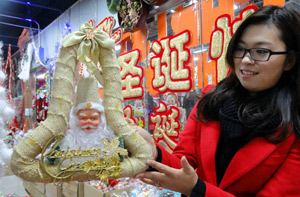 Xmas decorations hit the market
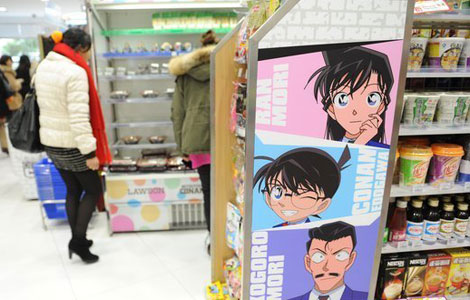 Conan themed convenience store opens in Shanghai
 Lights on cars and models in Guangzhou
 Solar greenhouse boosts modern agriculture
 Crew ready for Harbin-Dalian high-speed rail
 Ginger vendor pursues dream of writing
 Models shine at Guangzhou auto show
Copyright 1995 - 2010 . All rights reserved. The content (including but not limited to text, photo, multimedia information, etc) published in this site belongs to China Daily Information Co (CDIC). Without written authorization from CDIC, such content shall not be republished or used in any form. Note: Browsers with 1024*768 or higher resolution are suggested for this site.
License for publishing multimedia online 0108263 Registration Number: 20100000002731