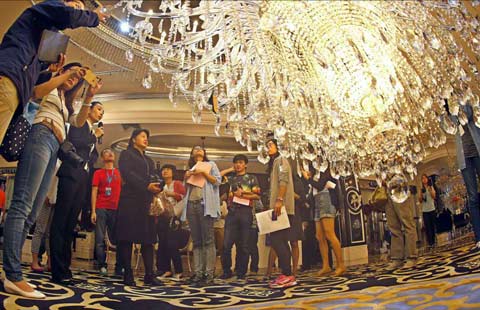
The Central Economic Work Conference set urbanization high on its work agenda for next year. [Photo/ Xinhua]

Reforms expected to meet tough challenges as China's new leaders mark out path for economy in 2013
The annual Central Economic Work Conference, where China's leaders set economic policy for the following year, was held in Beijing during Dec 15-16 -the first significant meeting since the new leadership took power last month.
A statement released after the two-day conference indicates that increased domestic consumption will play a fundamental role in economic development, and that opportunities from increased urbanization will be a main driver in this process.
In terms of macroeconomic policy, the statement says that the government will adopt a proactive fiscal policy and prudent monetary policy, and will continue to control property prices.
On the global economy, the statement says, although it will continue to grow slowly next year, it is still complex and full of possibilities for change. But protectionism is on the rise, and there is greater risk of inflation and asset bubbles.
"The world economy has entered a transformation stage from the high-speed increase stage before the crisis," the statement says.
The changing international environment means new opportunities for China's economic development, it adds. Previously, there were opportunities to integrate into the global distribution system, expand exports and increase investment. Now, China has to shift to expanding domestic consumption, improving innovation, and changing the pattern of economic growth.
China will continue to maintain its share of the international market, let imports play a supporting role in the structural change within the country and achieve a balanced international account. It will stabilize the scale of foreign investment in China, while expanding investment overseas.
In adopting a prudent monetary policy, the government aims to expand the scale of social financing, increase loans, keep the exchange rate of the Chinese currency stable, and lower the financing costs in the real economy.
It will pay more attention to risks in the finance sector, making sure there is none in systematic and regional finance.
"This suggests that the government is not yet concerned about the rapid pace of growth," Tao Wang, economist with UBS, wrote in a report. "The statement on lowering financing costs could mean increasing corporate access to credit, including through the bond market and small financial institutions, and not necessarily cuts in official lending rates."
Tao expects next year's GDP growth target could be set at 7 percent or 7.5 percent, and to recover to 8 percent in 2014 on the back of higher infrastructure spending and a property recovery.
The conference also promised to deepen economic reform. It plans to "enhance systematic reform, and push the next step of reform with bigger political courage and wisdom", the statement says.
It is to carry out the reform measures that have been published, and put in place new measures to resolve current prominent conflicts.
This shows that the government has recognized the need for coordinated reforms and significant breakthroughs in certain areas after years of a gradualist approach, and 2013 will be the year of gathering ideas and forming consensus for big reforms to come, says Wang of UBS.
"Officials appear confident enough about the current state of the economy to be focusing attention on the need for economic reform," says Mark Williams, chief economist of Capital Economics, a London-based research agency.
Huang Yiping, an economist with Barclays, adds: "We think the new leadership is fully aware of the tough challenges it faces in the coming years, so simply maintaining the status quo is not an option.
"But even if the government takes decisive action, it will take time to draw up the necessary plans and build consensus among key stakeholders. Any systemic reforms are more likely to be proposed at the third plenary session of the CPC Central Committee in autumn 2013."
It is encouraging to see that the work conference has called for greater political courage and wisdom to promote the reform on China's economy, says Duncan Freeman, research fellow at the Brussels Institute of Contemporary China Studies. The key economic challenges that China faces are in the financial system, the role of state-owned enterprises, tax and the social security system, and these will require major political efforts from the government to push through, he says.
Urbanization is highlighted in the government agenda, and is seen as a new engine for economic growth. This is a sector that many European businesses could benefit from, say government officials and experts.
"Urbanization is the biggest potential for expanding domestic consumption," the statement says. Ecological principles should be integrated to make the process "intensive, intelligent, green and low carbon".
Janez Potocnik, European commissioner for the environment, says the emphasis on environmental protection will bring tremendous economic opportunities for European businesses.
"China has become an extremely important player when it comes to global environmental issues," he says. "This is clear to everyone, and I have personal experience of the importance of China in the international negotiations on the need for greener economy and biodiversity."
He says the vision of Europe and China is very similar on environmental issues in future development.
"Like the EU's blueprint, China's strategy has put emphasis on very similar aspirations to improving efficiency in using natural resources, including energy and introducing new targets for the reduction of key pollutants," says Potocnki. "Both China and Europe recognize that our future economic growth needs to be based on green growth."
Europe is also looking for more measures to open access to China's public markets, to allow investment in service and finance, and to equalize credit conditions for public and private firms, says Francois Godement, professor at the Paris Institute of Political Studies. "From a French or European point of view, the accent on urbanization is welcome because this is an area where we have much expertise and engineering to offer - if the market is open," says Godement.
Li Xiang, Fu Jing and Liu Jia contributed to the story.
diaoying@chinadaily.com.cn
Related Readings:
China's reform targets policy mismatch
China to firmly promote economic reforms, opening-up


Copyright 1995 - . All rights reserved. The content (including but not limited to text, photo, multimedia information, etc) published in this site belongs to China Daily Information Co (CDIC). Without written authorization from CDIC, such content shall not be republished or used in any form. Note: Browsers with 1024*768 or higher resolution are suggested for this site.
License for publishing multimedia online 0108263 Registration Number: 130349