A study of five-year economic programs in central and western China shows that many of them have a similar list of development priorities.
Nearly all have pledged major efforts regarding the same seven "strategic emerging industries" as defined by the central government.
In the central part of China, four provinces - Henan, Hubei, Anhui and Jiangxi, adjacent to one other - have listed automaking as a regional pillar industry.
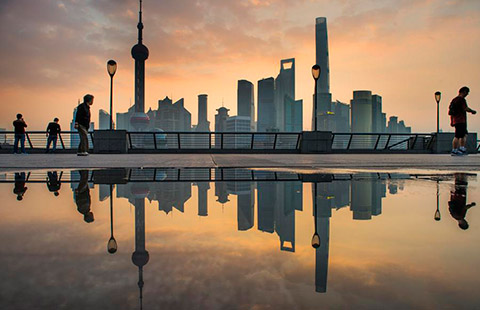
Even in the design of local buildings, cities tend to copy the landmarks of Beijing or Shanghai.
Cao said what surprised him in his research of regional GDP growth was that there are not only similarities in the speed of growth, but also in many characteristics.
"The underlying logic is that the central and western regions are basically copying the industries along the eastern coast. Their similar growth rates are but an outcome of their fundamentally identical industrial structures."
These similarities are attributed to two inter-related factors. One is encouragement from the central government, which is part of its overall emphasis on GDP growth. The other is local governments' preference for capital-intensive, or expensive investment projects, because they tend to generate higher GDP growth figures than business activities in a market economy.
Such a single-minded pursuit of GDP growth must be redressed, Cao said, to ensure there is "a greater diversity of regional development efforts". And officials' performance must instead be "measured by a variety of standards".
Local governments' pursuit of capital-intensive projects is dangerous, warned Zhang Monan, a researcher with the State Information Center. Once they drain government coffers, these projects can easily encounter problems and affect the whole country's financial state.
Local government debt, according to China Credit Rating Co Ltd, reached 580 billion yuan in mid-November, an increase of 150 billion yuan year-on-year.
What so much debt results in, Cao pointed out, is industrial overcapacity and a waste of valuable resources. It would be against basic economics, and certainly be no way to develop a region's comparative advantage, to let all regions develop similar industries equipped with similar technologies.
Can any central and western region eventually catch up with eastern regions by following such a "me-too" strategy? Peng, the Wuhan-based economist, does not think so.
For example, the growth rate of Guangdong province, the nation's economic powerhouse, was 7.9 percent in the first three quarters of 2012, which amounted to 321.4 billion yuan.
Whereas Central China's Henan province, which has almost as much land and people as Guangdong, grew 10 percent over the same period. But in absolute terms, this increase was worth 217.7 billion yuan.
This means that, despite Henan's faster growth, the gap between the two provinces has actually grown, Peng said.
Understandably, recasting a region's economic model is a long and sometimes painful process. But there are silver linings, and East China's Zhejiang province may be one of these.
In the first three quarters of the year, as Zhejiang's GDP grew 7.7 percent year-on-year, its service industries grew 9.2 percent and contributed more than 4 percentage points to GDP growth, according to the provincial government.
Investment in Zhejiang's service sector, excluding real estate development, surged 32.7 percent year-on-year, whereas the latter, due to the restrictions imposed by the central government, was suffering a setback in sales and prices.
Even with real estate development included, investment in Zhejiang's service sector still managed to increase 27.3 percent.
What happened in Zhejiang is remarkable, said Zhuo Yongliang, director of the Zhejiang Provincial Development and Reform Research Institute, because in most other provinces, real estate investment tends to grow much faster, instead of slower, than the general service sector.
Zhejiang's service sector, and its entire economy, may seem to be shedding the model of real estate-led growth ahead of the rest of China.
Zhejiang's service sector revenue also registered faster growth of 9.2 percent year-on-year in the first three quarters than the 6.8 percent notched up by its manufacturing sector during the same period.
Special Coverage

Related Readings
Wealth growth shifts inland from coastal regions
Economic engines rev up in inland regions
China regional economic gap narrows
Regions register faster GDP growth


Copyright 1995 - . All rights reserved. The content (including but not limited to text, photo, multimedia information, etc) published in this site belongs to China Daily Information Co (CDIC). Without written authorization from CDIC, such content shall not be republished or used in any form. Note: Browsers with 1024*768 or higher resolution are suggested for this site.
License for publishing multimedia online 0108263 Registration Number: 130349