Printing self-illusions a risky game


In the past four years, central banks in the advanced economies have been opting for new rounds of quantitative easing (QE) because the global financial crisis has exhausted the traditional instruments of monetary policy. And with investors seeking higher returns, more QE has been driving "hot money" (short-term portfolio flows) into high-yield emerging-market economies.
As these monetary policies remain in place, they are growing less effective, but continue to inflate potentially dangerous asset bubbles in Asia, Latin America and elsewhere.
Initially, these policies were characterized as "extraordinary" but "temporary". The goal, or so it was said, was to support the recovery and create foundations for solid growth.
But have these policies really improved economic prospects?
In the early days of the global financial crisis, even the most informed observers were hopeful. US Federal Reserve Chairman Ben Bernanke saw "green shoots" in the US economy as early as in spring 2009.
At the end of 2010, the annual growth of the advanced economies was 3 percent and projected to be 2.5 percent by 2012. In turn, emerging and developing economies were growing at 7.1 percent and their growth was expected to be 6.5 percent by 2012.
Nevertheless, the realities proved very different.
In the next two years, the expected growth of the advanced economies was almost halved to 1.3 percent, while that of the emerging and developing economies decreased by one-fifth to 5.1 percent. Most major forecasts were significantly downgraded by almost every organization, from the largest investment banks to the International Monetary Fund.
Today, these forecasters expect the advanced economies to grow by 2.2 percent and the emerging world by 5.9 percent in 2014. However, if you take a careful look at their most recent forecasts, you will find that these projections, too, have been downgraded, one quarter after another.
Such deviations are not irregularities or anomalies, but a pattern. During the past four years, the expected growth of the advanced economies has been hugely over-estimated and the impending risks vastly under-estimated. It is the same pattern that has justified the systematic extension of supportive monetary policies in all major advanced economies.
In September 2012, the Fed expanded its holdings of long-term securities with open-ended purchases of $40 billion of mortgage debt a month to hold the federal funds rate near zero until 2015. The goal was to boost growth and reduce unemployment.
In late summer 2012, European Central Bank President Mario Draghi pledged to do "whatever it takes" to preserve the euro. The pledge was followed by the Open Monetary Transactions program to provide liquidity to sovereign debt markets. The goal was to reduce tensions and boost market recovery in the eurozone.
Recently, the stimulus package of the new Japanese government, coupled with the anticipation of aggressive monetary easing and reforms, has driven Japanese stocks sharply higher and the yen significantly lower. That, in turn, could unleash a series of new currency rivalries.
During the past four years, the bloated balance sheets of the central banks of the United States, the European Union and Japan have doubled and then almost tripled to almost $10 trillion.
In the US, lingering stagnation has replaced solid growth, and unemployment hovers around 8 percent. Labor force participation has plunged and monthly job creation is significantly below what is needed for a solid recovery. Before the crisis, unemployment was below 5 percent. Now the target is 6.5 percent. Structural unemployment may have come to stay.
Unemployment in the eurozone has soared from 7 percent to 12 percent in the same period, and the region is in recession again. In the ailing southern periphery, the unemployment rate is twice as high and youth unemployment more than 50 percent.
In Japan, the third lost decade has begun. The economy is near stationary, and the worst days of population decline are still ahead.
Structural reforms can no longer be deferred in these major economies, which must soon cope with aging populations, rising healthcare costs and reduced growth. However, the awakening cannot occur until the era of highly accommodative monetary policies has eclipsed.
In the developed world, these monetary policies are not supporting growth and employment but translating into deleveraging, deflation and depreciation. In the emerging world, the same policies contribute to potential asset bubbles, inflation and appreciation. In adverse scenarios, such challenges could either slow down or disrupt the emergence of Asia as the global economic powerhouse.
In fall 2010, Brazil's Minister of Finance Guido Mantega warned of "currency wars',' following the Fed's QE moves. After two years of further debasing, currency rivalries are moving to a new phase.
While these monetary policies create a perception of stability, they also provide a pretext to defer structural reforms, which, in turn, creates a moral hazard. In Washington, this status quo has resulted in a prolonged fiscal cliff. In Brussels, muddling through has postponed change (and yet the ECB's liquidity injections have boosted the value of the euro to the stunning $1.36). In Tokyo, the standoff has discredited a generation of political leaders.
The "unexpected" shrinking of the US economy in the end of 2012 was not unexpected at all, but a foretaste of what's ahead with fiscal adjustment in the developed world. What's worse, any perception of stability could prove elusive if the US fiscal cliff fails to lead to a credible, bipartisan medium-term adjustment plan, if eurozone is swept by new turmoil, or if markets lose faith in Japan's huge debt.
Theoretically, bloated central bank balance sheets in the developed world are a means to an end. In practice, they have become a part of the problem.
Printing self-illusions is a dangerous way to play with fire.
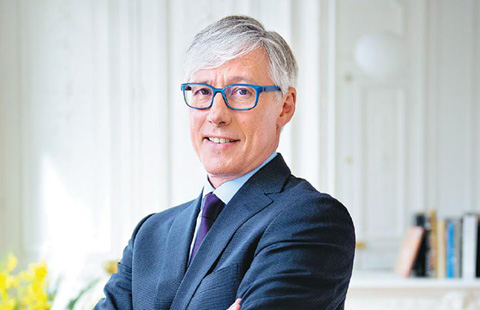
The author is research director of international business at India, China and America Institute (US) and visiting fellow at Shanghai Institutes for International Studies (China) and EU Centre (Singapore).